
Nazis of Tibet: A Twentieth Century Myth
Isrun Engelhardt
Abstract
In this paper I have two aims: first, to describe the long, multilayered and complex process that finally generated an alleged Nazi-Tibetan connection; second, to lay to rest the oft-repeated claim that the Ernst Schäfer Tibet expedition of 1938–39 had some occult purpose.
To accomplish this, I outline the development of the occult perception of Tibet and the occult myth of Nazism, and then describe the history of the expedition. Since this expedition forms the core of any discussion involving the links between National Socialism and Tibet, I next describe how the myth of occult elements in the Schäfer expedition was subsequently created from a variety of often unrelated elements to eventually become an object exploited by the authors of speculative historiography. After seeking to separate the fact and fiction as they appear in the most influential works of this genre, I propose an explanation for this kind of occult historiography based on the concept of conspiracy myths. The essay concludes by demonstrating how the prevailing and persistent occult perception of this mission has retained far-reaching consequences to the present day, with the result that the Tibetans and the Dalai Lama are either subsumed by the right wing and neo-Nazis, or demonized by the Left as agents of a Tibeto-Buddhist global conspiracy.
Our brains grew accustomed to connecting, connecting everything with everything else. “The refuge: It’s Tibet.” “Why Tibet?” “The refuge is Agartha. You gentlemen must have heard talk of Agartha, seat of the King of the World, the underground city from which the masters of the World control and direct the developments of human history. You must be aware of the connection between the realm of Agartha and the Synarchy.” “… but anti-German documents circulated that prove synarchy [rule by secret societies] was a Nazi plot: Hitler was a Rosicrucian influenced by the Masons.” “When did we ever invent anything? We’ve always started with objective data, with information in the public domain.”¹ Umberto Eco, “Foucault’s Pendulum”
Table of Contents
- Introduction
- The Invention of “Unknown Superiors” and “Hidden Masters” in Tibet
- Creation of Western Myths of Shambhala and Agarthi as Subterranean Theocracies
- Construction of the Mythology of the Nazis and the Occult
- The Legends of “Vril” and the Thule Society linking Nazism with Tibet
- Facts about the Schäfer Expedition
- Myths and Fictions about the Schäfer Expedition
- An Attempt at Explanation, based on Considerations of Conspiracy Theories
- Ironic Paradox: Nazi Construction of Tibetan World Conspiracy
- Neo-Nazi Constructions of a Nazi-Tibet Connection
- Recent Constructions of a Tibetan World Conspiracy Myth
- Notes
Introduction
In July 2000, a large poster in shades of red and brown caught my eye, announcing a nationwide conference entitled “Irrationalism—Esotericism—Anti-Semitism” to be held at the Ludwig-Maximilian University in Munich. At the upper right corner of the poster was a picture of the Dalai Lama, surrounded by pictures of authors with right-wing and esoteric tendencies, and at the lower left—opposite the Dalai Lama—was a picture of Hitler.² Since that time, I have endeavored to trace how a connection could be construed between the Dalai Lama and Hitler.³
Searching the Internet for explanations of this confusing, and indeed shocking, association by entering the words “Tibet” and “Nazi” in the Google search engine, one is rapidly confronted with both the immediacy and the frisson associated with this topic in the electronic age; a search for these terms returns around a hundred thousand entries, with a further twenty thousand for “Nazi-Tibet connection,” most of them involving a “creative” reshaping of history.
Occult- or crypto-historians, those who are writing such speculative history, skillfully blur the borders between fiction and fact, illusion and reality. They document a speculative and crypto-history of occult forces and powers that invisibly govern or control history—facts that have hitherto remained hidden to serious historians, including the fact that the homeland of these powers, including the masters who direct the pattern of world affairs, is often identified as Tibet.
But what is the point of occupying oneself with this spurious historiography? Up to now, the genre has been largely ignored by serious historians. However, the danger of such lack of concern has been pointed out by John Roberts, who has argued that the power of this literature should not be underestimated: “Because the historian passed by, the charlatan, the axe-grinder and the paranoiac long had the field to themselves. In due course, the assertions of terrifying conspiracy and demoniacal subversions which they produced made historians even less inclined to take the subject seriously.”⁴ But historians must respond to simplified interpretations of history and attempt to uncover and correct popular myths, since simplifications and dramatizations of history continue to be a theme with relevance today and can spread like wildfire, particularly in the medium of the Internet. The theoretical inferiority of these ideas and publications, from an academic point of view, must not be permitted to obscure or belie their attraction, and their potential danger.⁵
The growth of the mythology of the occult inspiration of the Nazis and its dependence in part on a distorted view of an “occult” Tibet provides an instructive example of the way such patterns of thought can influence judgments far beyond the absolute scope of the matters at hand, and occult Tibet provided an ideal setting for the emergence of European conspiracy myths.
The Invention of “Unknown Superiors” and “Hidden Masters” in Tibet
Views of Tibet as the occult land par excellence were not derived from any actual experience of the land and its people. Remarkably, the “occultization” of Tibet was not set in motion by those who had actually been there; instead, it was attributed to sources who never set foot in that country and who may not even have existed.
One group seen as possible world-controlling hidden masters was the mysterious secret society of the Rosicrucians. As early as 1618, Heinrich Neuhaus, in his critique of the Rosicrucians, allegedly commented that one would seek them in vain in Germany since they had emigrated to India shortly after the society’s foundation and were living in the high plains of Tibet. This statement has been repeated by a number of scholars, but without a scrap of evidence.⁶ I have been unable to find any mention of Tibet by Neuhaus, even after repeated readings of his book. He merely writes that the Rosicrucians could not be seen because their whereabouts were unknown.⁷ However, the mere inference of a retreat to Tibet by the Rosicrucians is interesting in itself. In 1710 Samuel Richter, writing under the pseudonym of Renatus Sincerus, did write that the Rosicrucians were no longer in Europe since they had retreated to India to live in peace more easily.⁸ (From 1782 an offshoot of the Rosicrucians was formed that even took the name “Asiatic Brethren.”) Their destination was probably later shifted to Tibet since India was apparently not mysterious enough.⁹
When Gottlieb Baron von Hund founded the Masonry of the Strict Observance in the middle of the eighteenth century, he doubtless had in mind the Rosicrucians of the early seventeenth century.¹⁰ Its founder claimed to derive his knowledge and authority from “Unknown Superiors,” who at the proper time and in the proper place would make themselves known and to whom implicit obedience was due.¹¹
The myth of the imaginary retreat of the Rosicrucians and the “Unknown Superiors” certainly influenced the conception of the “Hidden Masters”¹² propounded by Helena Petrovna Blavatsky (1831-1891), the Russian founder of modern Theosophy. Her chief source of inspiration was her great-grandfather, Prince Pavel Dolgurukii, a member of the Strict Observance lodge.¹³ Thus eventually “the Russian Rosicrucianism’s legend of a worldwide network of Masters and a secret link with Tibet was a profound influence on HPB’s development.”¹⁴ Late in the summer of 1875, shortly before founding the Theosophical Society, she noted in her first notebook that she had received the order “to form a society—a secret society like the Rosicrucian Lodge.”¹⁵ She made the preposterous claim that she had spent seven years in Tibet, working with her mysterious hidden masters, who lived there but were not Tibetans. Tibet was their refuge from civilization.
In 1906 an anonymous article even appeared in the Theosophical Review by “A Russian,” which referred to an anonymous manuscript supposedly from 1784, where a Rosicrucian from Berlin, Simson, “said he had heard that the true Masonry will arise once more from the kingdom of Tibet.”¹⁶
The myth of the retreat of the Rosicrucians to Tibet was also taken up at the end of the 1920s by representatives of the Polaires, a group of French intellectuals, who were interested in occultism and orientated themselves on the Polestar.¹⁷ Jean Marques-Rivière, a student of Jacques Bacot, in his popular fictional autobiography À l’ombre des monastères thibétains,¹⁸ contributed to the further “occultization” of Tibet by positing once again the existence there of mysterious power figures. (It was not until 1982, in an epilogue to a new edition, that Marques-Rivière admitted that the texts he presented were accounts of his nightly dreams as a young student, intellectually stretched to the limits of his capacity during his waking hours.)¹⁹
In his “autobiography” he describes a supreme, mighty King of the World, superior in status even to the Dalai Lama and the Panchen Lama, and a “Council of the Twelve Nom’-Kan,” an organization that extends throughout the Orient and unites it in both a spiritual and political sense.²⁰ Alexandra David-Néel also reinforced the myth of Tibet as a country full of occult sciences and magicians, principally in Mystiques et magiciens du Tibet.²¹
By the time of the rise to power of the founders of the Nazi movement, the supposed existence of hidden world masters in Tibet was thus widely known, and often believed in, throughout Western Europe.
Creation of Western Myths of Shambhala and Agarthi as Subterranean Theocracies
The Western myths of the lands of Shambhala and Agarthi were created in parallel to the “Hidden Masters” myth, and also had wide popularity. Shambhala was indeed part of the belief system in Asia, a land from which a great king would emerge to bring peace to the world, but Agarthi was created from whole cloth to fill a need for a further mysterious realm beyond ordinary human knowledge.
In addition to popularizing the idea of Hidden Masters, Madame Blavatsky was the first to gain a large audience in the West for ideas of a hidden abode of spirituality in the East, and Tibet as a secret site of ancient spiritual knowledge. In The Secret Doctrine of 1888, based on a mysterious ancient text called the Book of Dzyan (probably created by Blavatsky herself), she popularized the first Western version of the Shambhala myth, linking the original Indian myth of Shambhala to other myths of legendary sunken islands (Lemuria, Atlantis) to produce a creation myth marked by esoteric and racist elements in which chosen survivors “had taken shelter on the sacred Island (now the ‘fabled’ Shamballah, in the Gobi Desert).”²²
The other popular hidden center of spirituality in the East had no source in history or Asian mythology. Louis Jacolliot created the myth of Agartha and mentioned it for the first time in the 1873 work Le fils de dieu.²³ This spurious legend of Agarthi or Agartha, was taken up and developed by French occultists from the end of the nineteenth century. In 1886 the holy city of Agartha was described in detail by Joseph-Alexandre Saint-Yves d’Alveydre in Mission de l’Inde en Europe.²⁴ This subterranean theocracy was apparently located under the Himalayas, from where its rulers directed global events. Its ruler, the Supreme Pontiff, presided over a spiritually and technologically advanced population many millions strong. The Polish explorer Ferdinand Ossendowski presented a further version of the Agarthi myth in his 1922 best seller Beasts, Men and Gods.²⁵ In his account, he claims that Agarthi is an actual kingdom lying under Central Asia. Its ruler, the King of the World, knows all powers of the world and can read the souls of men and the Book of Destiny. Although claiming that the history of Agarthi could be traced to an ancient Mongolian legend, he actually adapted the key elements of his account from Saint-Yves d’Alveydre.²⁶ While the Agartha or Agarthi myth has no Indian or Tibetan roots whatsoever, it still influenced the French traditionalist René Guénon in his widely read work Le Roi du Monde, published in 1927 and translated into many languages, in which he supported Ossendowski’s claims.
The topos of both a subterranean kingdom and an occult brotherhood in Tibet was also addressed by Theodore Illion in his popular Darkness over Tibet, although the work has no factual connection with Tibet.²⁷ He tells of an alleged visit to the “Secret City in the Valley of Mystery,” to a powerful “Occult Fraternity,” in “the Underground City of the Initiates.” Although their ruler pretended to be a “Prince of Light,” he “was really the Prince of Darkness in disguise.” The “City of Great Light Power” turned out to be the “City of the Evil One.” This “Occult Hierarchy” planned to control the world through telepathy and astral projection.²⁸ It may be worth noting that the Gestapo ordered Illion to furnish documentary evidence of his alleged visits to Tibet when he returned to Germany in 1941,²⁹ “since he was under suspicion of being a liar, who claimed he had visited Tibet although he had never been there.”³⁰
Thus two crucial concepts—that of a set of hidden masters and the existence of two possible realms where they dwelt, both of them in Tibet—were in place to influence interpretations of the purpose of the 1939 Schäfer expedition to Tibet.
Construction of the Mythology of the Nazis and the Occult
Careful study of the evidence does not support, however, the idea that National Socialism was inspired by and permeated with occult ideas and purposes, especially to the extent of seeking an alliance with secret powers in Tibet. This lack of evidence has not, however, prevented the growth of a large literature—both contemporary and later—on the subject.
Speculative historiography by French authors³¹ in the genre “Nazis and the Occult”³² and the influence of occult forces on Hitler paved the way for an assumed connection between occultism and National Socialism. “The lightning successes of the Nazis, both electorally and later militarily, together with their manifest evil, stimulated notions of their demonic inspirations” and “represented the Nazi phenomenon as the product of arcane and demonic influences.”³³
As early as 1933, a text of primary importance in this regard was published by Teddy Legrand,³⁴ who propounded an initial indirect connection between National Socialism and Tibet. However, it was not until more than a quarter of a century later that a part of this work received widespread attention and further elaboration by Louis Pauwels and Jacques Bergier, who included a passage from it, without attribution, in their “key work” The Morning of the Magicians, a best seller translated into many languages that opened the floodgates for similar publications. However, the authors, who were addicted to a fantastic realism, had themselves downplayed the importance of their work and warned that many of their claims were as fantastic and exaggerated as Marco Polo’s accounts of his travels.³⁵ A direct comparison between the texts of Legrand and Pauwels and Bergier is included below in the section titled The Legends of “Vril”.
Hitler himself has been represented as an occult figure, despite his own stated scorn for interest in the occult. The most influential publication for the “occultization” of Hitler was Hermann Rauschning’s 1939 publication of a forged collection of talks with Hitler, Hitler Speaks,³⁶ intended to present Hitler as an infernally-inspired foe. In the spring of 1939, Edouard Saby published Hitler et les forces occultes, in which he depicts Hitler “as the sorcerer’s apprentice” and manufactures occult connections between Hitler and Tibet: “Wasn’t it Trebitsch-Lincoln, the friend of the Tibetan Badmaiev, who initiated Hitler, by revealing to him the doctrine of Ostara, a secret school of India, where the lamas teach the supremacy of the Aryan?”³⁷ C. Kerneiz’s work La Chute d’Hitler, published in 1940, attempts to analyze Hitler “cosmo-biologically” and claims that the group around General Ludendorff of all people, with whom Hitler was in fact almost unconnected, had subjected Hitler to a course of training of a type practiced in India and Tibet since time immemorial.³⁸
Some Nazi party leaders, principally Himmler and Rosenberg did have strong mystical leanings, but these were falsely extrapolated to apply to the entire Nazi ruling elite, including Hitler. According to today’s standards of historical research,³⁹ however, Hitler himself dismissed occultism and was skeptical of others’ occult ambitions, mocking the mystical interests of Himmler and Rosenberg⁴⁰ in a speech at a Kulturtagung on September 6, 1938:
National Socialism is a cool and highly reasoned approach to reality based upon the greatest scientific knowledge and its spiritual expression … Above all, National Socialism is a Volk Movement in essence and under no circumstances a cult movement! […] For this reason, the infiltration of the movement by mystically inclined researchers into the otherworldly cannot be tolerated. They are not National Socialists, but something else—certainly something with which we have nothing to do. […] Cult-like acts are not our responsibility, but that of the churches.⁴¹
Hitler also scoffed at astrology and horoscopes.⁴²
All of this is supported by the fascinating new book by Corinna Treitel, A Science for the Soul,⁴³ whose “approach to the history of German occult contrasts strongly with the prevalent view among historians,” and challenges the view of the early and highly influential book by Hugh Trevor-Roper, The Last Days of Hitler,⁴⁴ about the connection between Nazism and the occult. She writes that “as a careful examination of printed and archival sources shows, the larger story of the Nazi regime and the occult movement is one of escalating hostility,” and state officials “did not hesitate to oppress the occult movement brutally.”⁴⁵ And “an official decree in July 1937 dissolved Freemasonic lodges, Theosophical circles and related groups throughout Germany. Occult action now became illegal. Then in 1941, in the wake of Hess’s flight to Britain, police action against occultists rose to fever pitch.”⁴⁶
Furthermore, the subject of Tibet and its religion appeared alien and irrelevant to Hitler. He did say that in his youth the figure of Sven Hedin had been of great interest to him,⁴⁷ so he must have had at least some vague knowledge of Tibet. But the following remark made about Hitler in his Wolfsschanze headquarters on May 14, 1942, demonstrates his later lack of concern for Tibet: “At lunch, the boss [Hitler] was told about the film about Tibet made by the SS Schäfer expedition. The boss said that if anyone tried to criticize a Tibetan priest, the whole of the Catholic Church and the Protestant Church too would scream blue murder.”⁴⁸ This statement also clearly shows that the content of the film Geheimnis Tibet was not presented to Hitler as a Nazi propaganda film. It is noteworthy that Hitler made this comment in connection with Schäfer’s visit to the Führer’s headquarters. However, Schäfer neither met Hitler personally, nor was the disappointed Hitler able to grasp the significance of the gifts from the Tibetan regent which Schäfer was finally able to present to him, via Hitler’s adjutants, three years after his return from Tibet.⁴⁹
The Legends of “Vril” and the Thule Society linking Nazism with Tibet
But how did Nazi occultism become linked, however falsely, to secret centers of knowledge in Central Asia? This connection is attributed to the Vril Society and the Thule Society. As early as 1871, in his novel The Coming Race,⁵⁰ which also inspired Blavatsky,⁵¹ Edward Bulwer-Lytton described a subterranean race of Übermenschen, the Vril-ya. These “superbeings” were far in advance of humanity in every respect, due to their ability to tap a mysterious force or energy to which Bulwer-Lytton gave the name “Vril.” From these roots, the Vril Society emerged in Germany. The association’s existence is corroborated by nothing more than a single reference in a brief essay written in 1947 by rocket engineer Willy Ley, who emigrated to the USA in 1935: “The next group was literally founded upon a novel.” This Berlin group called itself Society for Truth and “devoted its spare time to looking for Vril … The secret of Vril could be found by contemplating the structure of an apple, sliced in halves.”⁵²
This brief report was taken up by Pauwels and Bergier in The Morning of the Magicians to inflate the significance of this unknown group and to insinuate the determination of the Nazi ruling elite to make contact with an omnipotent subterranean theocracy, thus enabling Germany, armed with the knowledge of this power, to conquer the world. The group was known as the Vril Society or the Luminous Lodge, and the geo-politician Karl Haushofer was said to have been a member.⁵³
An influential role as an occult center of the National Socialist elite was also attributed to the Thule Society, founded in Munich in 1918. According to Pauwels and Bergier it was said to be part of a network of occult groups and associations, some with origins dating back to far-distant times and places. The society not only functioned as an organization of occult adepts, but primarily served as a direct point of contact to supernatural powers or as a link to the “Hidden Masters,” chiefly in Tibet, to whom secret knowledge, superhuman abilities and occult powers were attributed.
With Karl Haushofer having been identified already by Pauwels and Bergier as Hitler’s occult mentor,⁵⁴ the Thule Society was said to have played a key role in the development of National Socialism. Pauwels, himself a disciple of the holistic master Géorge Ivanovich Gurdjieff, claimed that Haushofer, who traveled through India, Burma, Korea and China from 1908-1910, was Military Attaché at the German Embassy in Tokyo, and had a lifelong interest in the Far East and Japan in particular, met Gurdjieff several times in Tibet⁵⁵ between 1903 and 1908:
In 1923 Haushofer founded an esoteric group modeled on similar groups in Tibet … The group was called the “Thule Group” and its philosophy was founded on the famous book of magic of the Dzyan, which belonged to certain Tibetan sages; according to this book there were two sources of power in the world: the right-hand source, which comes from a subterranean monastery, a fortress of meditation, situated in a town called, symbolically, Agarthi. This is the source of the contemplative power. The left-hand source is the source of physical power, and comes from a town on the surface called Shampullah. This is the city of violence and is ruled by the “King of Fear.” Those who succeed in making an alliance with him can dominate the world. Through a large Tibetan colony in Berlin which kept constantly in touch with Haushofer, the “Thule Group” formed this “alliance” in 1928 … The following men were members of the group at this time: Hitler, Himmler, Goering, Rosemberg [sic] under Haushofer’s direction. The members communicated in two ways with Shampullah and the “King of Fear”: firstly, by electronic transmitters and receivers which put them in contact with a so called “Tibetan” information centre through which they obtained valuable comments on India and Japan …
The treacherous insinuations were further magnified: “They [my informants] affirm, too, that one of the conditions of the pact made between the ‘Thule group’ and the Tibetan ‘authorities’ was the extermination of Gypsies.”⁵⁶
However, this sensationalized picture of the Thule Society and its members is a complete fabrication. As in later works, Pauwels inverted the Theosophists’ positive concept of Shambhala into its opposite. Hitler never took part in a single meeting of the Thule Society, nor was Göring a member. Among those Nazi leaders known to hold esoteric beliefs, Himmler was never associated with the Thule Society. While Alfred Rosenberg had contact with the society, the esoterically influenced Rudolf Hess was the sole leading Nazi who was a member.
But what was the Thule Society actually? It was certainly not an occult group. During the rise of Nazism the Thule Society took on certain significance as a racist, anti-Semitic and völkisch, albeit not an occult group, particularly in the crushing of the Munich Räterepublik (Republic of Councils). After 1919 the group’s political influence dwindled.⁵⁷
The claims concerning Haushofer’s contacts with and membership in the Thule Society and Vril Society have no foundation whatsoever, and Pauwels’s allegations of meetings between Haushofer and Gurdjieff in Tibet do not withstand critical examination. Haushofer did not travel outside Europe prior to 1908, and his precisely documented schedule through Asia allowed no time for a visit to Tibet⁵⁸ or for a meeting with Gurdjieff.⁵⁹
Thus it can be seen that Nazi concern with occult beliefs and mysterious powers available to them in the East have been greatly exaggerated, to say the least.
Facts about the Schäfer Expedition
Let us now turn to the project in which the myths and legends described above appear to culminate: “No expedition to Tibet so captured public attention with its plans than a group of five German researchers shortly before the outbreak of the Second World War.”⁶⁰ This expedition constitutes the main piece of “evidence” used by crypto-historians in their construction of a Nazi-Tibet connection. Here only the main points of the expedition, those bearing on later insinuations, since a more detailed account is available elsewhere.⁶¹
This 1938/39 Tibet expedition, although planned by its members as a purely scientific venture, actually fell between the two stools of politics and science from the very outset of its planning stage. Heinrich Himmler and the “Ahnenerbe” (the SS Ancestral Heritage Society) wanted to influence and determine the venture from a political, esoteric, and pseudo-scientific viewpoint. The expedition then fell into the area of foreign affairs conflicts when official permits were required from the English. National Socialist foreign policy, political affiliations, and propaganda ultimately damaged the completion of the expedition’s goals and created enormous obstacles for it.
Ernst Schäfer, born in 1910 in Cologne, had just started to study zoology and geology in Göttingen when Brooke Dolan, a wealthy young American, came to Germany in 1930 to recruit scientists for a zoological expedition. Schäfer, a mere twenty years old at the time, participated in the first Brooke-Dolan expedition to Western China and Tibet.⁶² In 1932 he returned to Germany to resume his studies and joined the SS in 1934. From 1934 to 1936 Schäfer took part in a further scientific expedition with Brooke Dolan, this time as scientific leader, to Eastern Tibet and China.⁶³ After his return to Germany, Schäfer continued his studies in Berlin and received his doctoral degree in zoology in 1937.
Meanwhile, the success of the expeditions Schäfer had participated in had attracted Heinrich Himmler’s attention. Despite his ambivalence towards Asia as a whole, Himmler, who was fascinated by lurid, fantastic ideas of Asian mysticism and believed in karma, had a genuine interest in Tibet.⁶⁴ When he heard about Schäfer’s plans to lead an independent expedition to Tibet, he was immediately keen on launching this expedition under the auspices of the SS “Ahnenerbe.” A memorandum from the “Ahnenerbe,” dated August 1937, finally stated that the Reichsführer wished “the ‘Ahnenerbe’ to equip a new expedition to Tibet. The expedition is to be organized officially by the ‘Ahnenerbe’.”⁶⁵
The “Ahnenerbe,”⁶⁶ founded in 1935 in Berlin by Himmler and others, initially occupied itself with subjects such as early Germanic history, runic research, and fringe subjects like the Atlantis myth. However, it was increasingly endeavoring to gain a foothold in the field of serious science, to extend its scope of study to focus on natural sciences, and to attract first-class scientists, so that it was concerned with both areas in parallel.
Himmler constantly attempted to influence the work of scientists when he discovered a topic that interested him.⁶⁷ Indulging his mystical bent, he wanted Schäfer and his expedition to conduct research based on Hörbiger’s “World Ice Theory,” which claimed that Atlantis was destroyed by a great flood caused by the collision of an ice moon with the Earth. “Himmler believed that ancient emigrants from Atlantis had founded a great civilization in Central Asia, the capital of which was a city called Urbe.”⁶⁸
However, as a scientist Schäfer had more legitimate purposes in mind, and several times declined—eventually with success—to include on his team the pseudoscientist Edmund Kiss, whose task would have been to furnish proof of this theory. The primary objective of Schäfer’s research was the creation of a complete scientific record of Tibet, through a synthesis of geology, botany, zoology, and ethnology, referred to in the German science of the day as “holism.”⁶⁹
The difficulties of travel to Tibet and the hardships facing the expedition were dwarfed by the problems Schäfer faced in organizing and financing the project. Although he had succeeded in asserting his scientific freedom over Himmler’s wild plans,⁷⁰ his objectives and those of Himmler and the “Ahnenerbe” apparently diverged more and more widely until Wolfram Sievers, the head of the “Ahnenerbe,” declared in January 1938 that “In the meantime the task of the expedition has diverged too far from the goals of the Reichsführer-SS and does not serve his ideas of cultural studies”⁷¹ “because it would lie outside the scope of his work.”⁷² “The Reichsführer complied with Dr. Schäfer’s request to be permitted to conduct negotiations himself concerning the expedition’s financing and organization. The “Ahnenerbe” subsequently transferred the file to Dr. Schäfer.”⁷³ And later: “At the request of the Reichsführer SS, SS Obersturmführer Schäfer’s expedition was not conducted by the ‘Ahnenerbe’.”⁷⁴ Doubtless financial factors also played a key role in this decision.
Thus, in the end, the expedition was not sponsored or financed by the SS or the “Ahnenerbe.” However, Schäfer continued to receive political help from the “Ahnenerbe” and Himmler. He was well aware of the fact that he was dependent on Himmler’s goodwill, and was forced to compromise on some points in order to retain his support with the English and obtain passports. Himmler gave his consent to the expedition on the condition that all of its members join the SS.
Himmler’s meddling was not always helpful in dealings with the English, however. In preparation for the expedition, Schäfer had had “Schäfer Expedition 1938/39” letterheads printed and applied for sponsorship from businessmen. Schäfer was forced to yield on the matter of the expedition’s official title. In February 1938 Himmler decreed that on the orders of the “Ahnenerbe” the expedition’s name would have to be changed and letterheads were ordered with the new text “German Tibet-Expedition Ernst Schäfer [in large print], under the patronage of the Reichsfuehrer-SS Himmler and in connection with the ‘Ahnenerbe’ ” [in small print].⁷⁵ This letterhead, in large Gothic type, caused Schäfer considerable difficulties with the British authorities after his arrival in India. The consequence was that Schäfer ordered new, discreet letterheads in Antiqua typeface, apparently while still in Calcutta, which stated simply “Deutsche Tibet Expedition Ernst Schäfer.” During the expedition he used only this and his original “Schäfer Expedition” paper.
Schäfer continued his efforts to establish the financing of the expedition and carry through his research objectives. He actually raised the funds of his expedition by his own efforts, albeit with the support of the “Ahnenerbe.” He received the sum of 30,000 Reichsmark (RM) from the DFG.⁷⁶ The final statement dated November 15, 1940, shows that the Public Relations and Advertising Council of German Business (Werberat der deutschen Wirtschaft) made the largest contribution, of RM 46,000. In return for supplying reports for the newspapers Völkischer Beobachter and the Illustrierter Beobachter, their publisher Eher Verlag paid the sum of RM 20,000; RM 7,000 came from the Foreign Office, and a further RM 6,500 from private donors including Brooke Dolan. The costs totaled RM 112,111, of which the greatest expenditure, RM 12,119, was to be for the ethnographic collection.⁷⁷ Only the contribution from Himmler’s “circle of friends” was the financing of part of the hasty return flight from India—the leg from Bagdad to Berlin—as the outbreak of war became imminent.⁷⁸
One of the greatest problems in those years was the procuring of foreign currency, which was only possible through Hermann Göring. Göring was a great hunting enthusiast,⁷⁹ and Schäfer, also a hunter, was introduced to him through the agency of Himmler at the Munich International Hunting Exhibition at the beginning of November 1937.⁸⁰ The meeting between the two hunters was successful, and the problem of foreign currency was solved.
The expedition was finally ready. It comprised five members: Schäfer as mammologist and ornithologist; Ernst Krause as entomologist, photographer, and camera operator; Bruno Beger as ethnologist; Karl Wienert as geophysicist; and Edmund Geer as technical caravan manager.
They set off in the spring of 1938, heading first to Calcutta. However, political reality caught up with them on their arrival. When they left, the National Socialist propaganda newspaper Völkischer Beobachter had printed an article headlined “SS Expedition Leaves for Uncharted Regions of Tibet.”⁸¹
The Indian Statesman immediately reprinted the article, but under the headline “Nazi invasion—Blackguards in India.” This would cause Schäfer enormous problems during negotiations with the English over entry permits for Sikkim and Tibet. The German Consul-General in Calcutta, Count Podewils, expressed unusually open and direct criticism to the Foreign Office:
I attribute the refusal [of the entry permits] primarily to the fact that the expedition was overly presented as an SS enterprise. The known fact that the English consider the SS to be a police and espionage organization could not do otherwise but cause the expedition’s scientific goals to be regarded as a mere pretext and scent political objectives in the background. The detailed article in the Völkischer Beobachter of 20 April, “Expedition into the Uncharted Regions of Tibet, Research Expedition with the Support of the SS Reichsführer and Völkischer Beobachter” was as unhelpful in this context as the letterhead “Deutsche Expedition Ernst Schäfer, Unter der Schirmherrschaft des Reichsführers der SS Himmler und in Verbindung mit dem Ahnenerbe e.V. Berlin,” which was used prior to the expedition’s departure. Naturally, the English learnt of all this immediately and became suspicious, so that not only the London Times, but also the local press published notes pointing out the expedition’s connection to the SS.⁸²
In support of Schäfer and his expedition, Himmler himself wrote a letter to his friend Admiral Sir Barry Domvile, a fact that also came to the attention of the India Office.⁸³ While Himmler’s intervention helped to get the required permits, the suspicion of the English had now been awakened in earnest. Even though Schäfer appeared to be successful in convincing the British of the exclusively scientific purpose of his mission, British suspicions of espionage clung to the expedition throughout its duration and imputed to it a far greater importance than was warranted.
Although the Tibetan government refused entry to the expedition several times, some months later Schäfer and his crew were admitted to Lhasa, where they stayed a full two months. The members of the expedition established official contact with the Kashag ministers and the Reting Regent, and friendly contact with many aristocratic families.
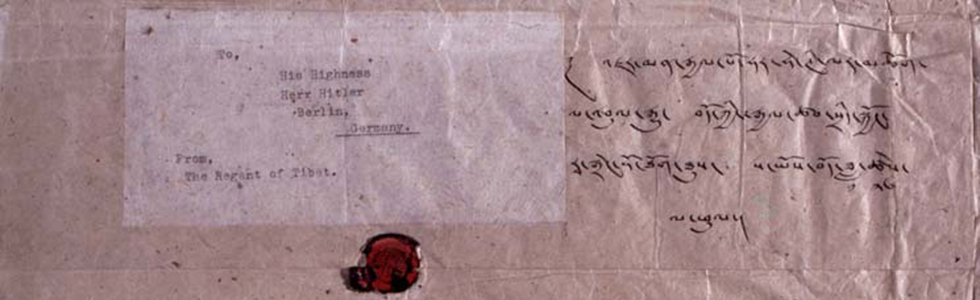
Given the myths surrounding the expedition’s alleged secret political aims, let us now focus on the contact with the Reting Regent and perhaps the most famous outcome of the expedition, the letter the Regent wrote to Hitler.⁸⁴ Schäfer convinced Reting to write a letter to Hitler, although Reting probably had little idea of who Hitler was. The letter, in the official accompanying English translation, reads:
To his Majesty Fuhrer Adolph Hitler, Berlin,
Germany.
From
The Regent of Tibet.
On the 18th day of the first month of Sand-Hare Year.Your Majesty,
I trust your Highness is in best of health and in every progress with your goodly affairs.Here I am well and doing my best in our religious and Government affairs. I have the pleasure to let Your Majesty know that Dr. Schaefer and his party, who are the first Germans to visit Tibet have been permitted without any objection, and every necessary assist is rendered on their arrival. Further, I am in desirous to do anything that will help to improve the friendly tie of relationship between the two Nations, and I trust your Majesty will also consider it essential as before.
Please take care of Your good self, and let me know if Your Majesty desire anything.
I am sending under separate parcel a Tibetan silver lid and saucer with a red designed tea cup, and a native dog as a small remembrance.
Sincerely Yours,
Reting Ho-Thok-Thu.
Although this letter is no more than an example of the noncommittal polite correspondence typical of Tibet, it gave rise to much speculation and is nowadays often cited as proof of the Tibetans’ friendly attitude toward Nazi Germany. In 1995 Reinhard Greve published the German translation of the Tibetan original by the Tibetologist Johannes Schubert. Schubert may have thought it advantageous to try to translate this letter in a Nazi style, and may thus have falsified the translation deliberately to flatter Hitler. But his translation is quite simply inaccurate. He even added remarks that are not found in the original document, the most egregious interpolation being the substitution of “At present you [Hitler] are making all efforts in creating a lasting empire in peaceful prosperity based on a racial foundation,” for the correct translation of the common Tibetan phrase: “Here I [Reting] am well and doing my best in our religious and Government affairs.”⁸⁵ Schubert’s inaccurate translation has since been used to demonstrate Tibetan sympathy for racist ideas and to ascribe to the Tibetan ruler an uncritical friendship toward the Nazis.⁸⁶
The expedition completed its projected work and was from a scholarly point of view highly successful, collecting an amazing amount of scientific material about Tibet that continues to be of great value even today. It ended, however, in a hasty and dispiriting return to Europe: some weeks after the return of its members the Second World War broke out.
These, then are the facts—the history—of this expedition, as far they can be reconstructed on the basis of the sources available at present.
Myths and Fictions about the Schäfer Expedition
The mere fact that a scientific expedition of SS members visited the mysterious land of Tibet at this time, shortly before the outbreak of the Second World War, has been enough to add weight to the fictitious occult links between Nazism, Hitler, and the “Hidden Masters” in Agarthi und Shambhala. But what of the distortions of fact and stories concocted on the basis of this history? And how was the expedition exploited to support myths of occult connections between Hitler, Nazism and Oriental theocracies?
Although Pauwels and Bergier were the most influential creators of the myth of a Nazi-Tibetan connection, they were not the first to do so; they used and expanded a story mentioned earlier in this article, one from a French spy novel of 1933, Les sept têtes du dragon vert, in which connections between the Tibetans and Hitler were fabricated.⁸⁷ Its author was allegedly a French secret agent writing under the pseudonym Teddy Legrand who was later said to have died under mysterious circumstances. The novel, which describes a powerful secret organization responsible for the rise of National Socialism and Communism, adroitly interweaves fact and fiction.⁸⁸ In the novel, two British secret agents in 1933 visited an Asian magician in Berlin described by the Berliner Zeitung as “the man with green gloves.” He had three times accurately predicted the number of Hitler’s supporters who would be elected to the Reichstag.⁸⁹ The Tibetan mala (rosary) with which the two British agents were presented—with 110 beads instead of 108, for occult reasons—implied that he was Tibetan, although this is not specifically mentioned. His fluorescent gloves gleamed like glow-worms. His gaze was cruel, penetrating and sly; he had perfect control over his reflexes. He addressed the British agents in perfect Oxford English: “Gentlemen, although you belong to a race other than mine, the green hand will be extended to you, since you bear the keys that open the 110 locks of the secret kingdom of Aggharti.”⁹⁰
Let us examine what Pauwels and Bergier made of this in their The Morning of the Magicians:
In Berlin there was a Tibetan monk, nicknamed “the man with the green gloves,” who had correctly foretold in the Press, on three occasions, the number of Hitlerian deputies elected to the Reichstag, and who was regularly visited by Hitler. He was said by the Initiates to possess the keys to the kingdom of Agarthi … It was in 1926 that a small Hindu and Tibetan colony settled in Berlin and Munich. When the Russians entered Berlin, they found among the corpses a thousand volunteers for death in German uniform without any papers or badges, of Himalayan origin. As soon as the [Nazi] movement began to acquire extensive funds, it organised a number of expeditions to Tibet, which succeeded one another practically without interruption until 1943. […]⁹¹
In Tibet, acting on orders from Dr. Sievers, Dr. Scheffer [sic] was in contact with a number of lamas⁹² in various monasteries and he brought back with him to Munich, for scientific examination, some “Aryan” horses and “Aryan” bees, whose honey had special qualities.⁹³
Here we find further occult details added to Teddy Legrand’s fictional story, but none of them have any basis in fact. No green-gloved Tibetan monk lived in Berlin to advise Hitler. Furthermore, far from a constant succession of German expeditions to Tibet from 1926-1943, only a single German expedition went to that country, that of 1938-1939.⁹⁴ There were also no Tibetan colonies in Munich, Berlin or other cities, no Tibetan monks, and no troop of uniformed Tibetans in Germany. In fact, in the first half of the twentieth century only a single Tibetan lived in Germany: he was Albert Tafel’s interpreter, whom Tafel had brought with him after his expedition in 1907.⁹⁵ There is also no proof at all for the claim of a thousand uniformed Tibetan corpses. This story may be a legend arising from the fact that in the Second World War Mongolian Kalmyks had fought on the side of the Germans, although at the end of the war there were almost no Kalmyks in Berlin.⁹⁶ Nonetheless, it was thus that the myth arose. Once “Pauwels and Bergier had provided this basic stock of myths relating to the occult inspiration of Nazism, further authors were tempted into a sensational field.”⁹⁷
Trevor Ravenscroft added to this repertoire of myths in his widely read work, also translated into several languages, The Spear of Destiny:
It was largely through the initiative of Professor Karl Haushofer and other members of the Vril Society in Berlin and Munich that exploratory teams were sent out to Tibet. The succession of German expeditions to Tibet, which took place annually from 1926 to 1942, sought to establish contact with Cave Communities and persuade them to enlist the aid of Luciferic and Ahrimanic Powers in the furtherance of the Nazi cause and in the projected mutation which would herald the new race of Superman.
Three years after the first contact had been made with the Adepts of Agarthi and Shamballah, a Tibetan community was established in Germany with branches in Berlin, Munich, and Nuremberg. But only the adepts of Agarthi, the servants of Lucifer, were willing to support the Nazi cause. The Initiates of Shamballah, who were concerned with the advent of materialism and the furtherance of the machine age, flatly refused to co-operate. Serving Ahriman, they had already made contact with the West and were working in affiliation with certain lodges in England and America! The adepts of Agarthi were known in Germany as “The Society of Green Men” and strong measures were taken to keep silence about their real significance. They were joined by seven members of the “Green Dragon Society” of Japan, with whom they had been in astral communication for hundreds of years. […]
During the final months of the war the lamas from Tibet were utterly neglected by the Nazis. They had failed in their mission to harness the powers of Lucifer to the Nazi cause. To show his personal disfavour Hitler ordered that they should live on the same reduced rations as the inmates of the Concentration Camps. When the Russians reached their quarters in the suburbs of Berlin, they discovered their naked bodies lying in orderly rows, each with a ceremonial knife piercing the abdomen.⁹⁸
This freely invented fantasy obviously incorporated dualist ideas taken from the anthroposophy of Rudolf Steiner. However, I was unable to discover any reliable information about the “Green Dragon Society” or the “The Society of Green Men.”
In the first book on this general topic in the German-speaking world, Dietrich Bronder’s 1975 Bevor Hitler kam, we read:
In 1928 the Thule Society, via the strong Tibetan colony in Berlin with which Haushofer was in permanent contact, is said to have resumed the links to Tibet’s secret societies of monks, which were even maintained during the Second World War. The key used in radio communication between Berlin and the Tibetan capital of Lhasa at this time was the book Dzyan, a secret book of magic of Tibetan sages.
The links to Tibetan Buddhism forged by Trebitsch, Haushofer, and Hess were represented by Karo Nichi, an emissary of the Tibetan Agartha in Berlin; he wore the brush-shaped moustache that indicated an adept. On the evening before the outbreak of the Second World War Schäfer’s SS expedition departed from Germany for Tibet, guided by Karo Nichi and Eva Speimüller, bringing the Dalai Lama radio equipment with which to set up links between Lhasa and Berlin. Schäfer’s SS men were permitted to enter the holy city of Lhasa, otherwise barred to Europeans and Christians—and even the lamas’ magnificent temple, containing one single enormous object, the holiest symbol of the Mongolian empire: the swastika.⁹⁹
Of course, the expedition was neither led by the unknown Karo Nichi, supposed emissary of Tibetan Agartha in Berlin, nor did it have the aim of supplying the Dalai Lama with radio equipment to pass messages between Lhasa and Berlin and establish an axis of the occult, as claimed by Dietrich Bronder. It is, however, correct that the expedition brought gramophones and a radio, which were presented to the Regent and the Kashag; however, these objects, which were part of the equipment of the expedition, were only converted into gifts during the course of the expedition.¹⁰⁰
The myth would be recycled and reconstituted in works in English, German, and French. Although the members of the Schäfer expedition had no knowledge of Illion’s Darkness over Tibet before 1941, the introduction to the currently available edition states: “It is believed that Illion’s accounts of Tibet were instrumental in persuading the Nazi government of Germany to send yearly expeditions into Tibet,”¹⁰¹ which “tried to find fossilized remains of giants. Anyone who attacked Hörbiger was promptly suppressed by the ‘Ahnenerbe’.”¹⁰² It is evidently of no importance that, as natural scientists, all members of the expedition categorically rejected the World-Ice Theory and specifically refused to allow it to be included as part of the expedition’s goals.
The sources continued to be equally creative, stating that there were “persistent rumors that the Nazi interest in Tibet was actually inspired by a desire to contact the black adepts of Shambhala and/or Agartha and to enlist their aid in the conquest of the world.”¹⁰³ Rudolf Hess is said to have cried in a moment of euphoria, “The secret powers of Tibet are fighting on the side of the Axis powers.”¹⁰⁴ And the German Tibet expedition was said to be an attempt by the Nazis to establish communications with true “supermen.”¹⁰⁵ In an American book, it is explained that these SS men “were the warrior elite of a new civilization, immeasurably superior to the old, the high priesthood of the New Age, the standard bearer of the coming Superman. Their leaders were magicians, who had formed alliances with the mystic Tibetan cities of Agarthi and Schamballah and had mastered the forces of the living universe.”In an American book, it is explained that these SS men “were the warrior elite of a new civilization, immeasurably superior to the old, the high priesthood of the New Age, the standard bearer of the coming Superman. Their leaders were magicians, who had formed alliances with the mystic Tibetan cities of Agarthi and Schamballah and had mastered the forces of the living universe.”¹⁰⁶
We read in a French work that “there was continuous contact between National Socialist Germany and Tibet and it is known that orders were issued directly by the imaginary fatherland of the Germans that concerned the material conquest of the world by the Seven Initiates of the Society of Thule. We know today that our merciless sectarians were magically ‘protected’ by their Tibetan masters under the sign of the swastika.”¹⁰⁷
The letter to Hitler from the Tibetan Regent also triggered speculations:
There were also claims that Schäfer had brought the Führer a document of inestimable value and that the Führer locked it away in a dark corner of the bunker at Rastenberg where he was said to meditate. However, this document was nothing more than a parchment on which the Dalai Lama had signed a pact of friendship with Nazi Germany, where Hitler was known to him as head of the Aryans. While it is possible that Schäfer brought such a document with him, it is not possible to estimate the value ascribed to it by all sides. Was it a declaration of principles, or merely a document of diplomatic value? […]
One item out of all those brought back by Schäfer deserves particular attention: the Tantra ritual Kalachakra and a detailed dossier concerning this Tantric initiation … the first document on this subject to reach the West.¹⁰⁸
Once again, however, reality is less mysterious. Of course, at this time the threeyear-old Dalai Lama had not arrived in Lhasa yet. And, as Bruno Beger confirmed to me, the expedition members were not even aware of the term Kālachakra¹⁰⁹ and brought no such documents back with them.¹¹⁰ Perhaps the authors had confused the term Kālachakra with the Kanjur (bKa’ ’gyur), a copy of which had been presented to the expedition in exchange for medical assistance. Yet even this fact galvanized other authors’ imagination and inspired speculations such as those of Dietrich Bronder: “Finally the [Panchen] Lama presented the SS expedition with the Lamaist bible Kanjur in over a hundred volumes, as a gift for his friend Hitler, or Hsi Talé.”¹¹¹ This last “fact,” however, would have exceeded the framework of space and time, since the Panchen Lama spent the last 15 years of his life outside Tibet and had died two years prior to the expedition’s arrival. A mystery has even been concocted about the fate of this copy of the Kanjur. Peter Levenda speculated: “I have been unable to discover what has happened to it after the war, though I suspect it wound up in a museum in Vienna.”¹¹² Peter Moon even added: “I have been informed by others that they [the documents] ended up in Russian hands and that they were copies of original sacred texts from the inner caves of Tibet. Monks would spend entire lifetimes dutifully copying sacred scriptures and depositing them in secret locations.”¹¹³ In fact, this impressive hundred volume edition of the new Lhasa Kanjur, initiated by the 13th Dalai Lama, has spent the last several decades in the Bavarian State Library in Munich.¹¹⁴
A greater problem, and a murkier one, than that of the work of occult or cryptohistorians, sensationalist writers, or conspiracists are publications by those journalists and self-styled “agents of enlightenment” who, while purporting to bring light into darkness and to demythologize Tibet, actually construct new myths by skillfully mixing fact and fiction—deliberately or not. For example, the American historian Lee Feigon explains: “In the late 1930s Hitler and Himmler went so far as to send an expedition to Tibet to measure Tibetan head sizes and ascertain that the Tibetans were not Jews but true Aryans. Hitler even is reputed to have brought a group of monks back to Germany, instructing them to perform special chants to alter weather patterns in preparation for his ill-fated Russian invasion.”¹¹⁵ Orville Schell, an American professor of journalism, reports: “Indeed, as early as 1926, long before they were a force to be reckoned with, future Nazi supporters managed to send the first of several ‘anthropological’ expeditions to the area under the leadership of zoologist Ernst Schafer.”¹¹⁶
The occult insinuations surrounding the expedition reappeared in 1997, when the release of the film Seven Years in Tibet, based in large part on his 1952 book,¹¹⁷ prompted research into Heinrich Harrer’s Nazi past. Among statements published at that time we find things like this:
In 1938 Schäfer left for Tibet with 30 men and a large cache of weapons, arriving in Lhasa in early 1939. […] The SS storm troops were on a mission to persuade the Tibetan army, by giving them gifts, to wean it away from British influence … The plan was … that it was the Tibetans who would teach the Germans how to survive in the harsh environment.¹¹⁸
And even more of a falsification:
Himmler believed that the Tibetans were fellow Aryans. Schäfer’s mandate was to turn the Tibetans against the British with the ultimate end of forming a German-Tibetan Aryan alliance that would eventually conquer Asia. Tibet would be then settled by colonies of Germans seeking the precious Nazi ideal of Lebensraum—“living space.”¹¹⁹
However, even if individual authors were forced to admit, after conscientious research and, for example, after searching all files in the National Archives in Washington, that they could find nothing “about the occult activities and interests of the Third Reich concerning Tibet,”¹²⁰ they often conclude with innuendo along the lines of this: “Thus we cannot rule out the hypothesis that Schäfer was involved in something more than butterfly gathering in this historic (and official) trek to the Himalayas at that time of great international crisis and global tensions.”¹²¹
An Attempt at Explanation, based on Considerations of Conspiracy Theories
What is it that compels authors to write such things? The root causes, the methods of representation and the conventions of the genre may be approached from the perspective of conspiracy theories,¹²² where events are interpreted from the viewpoint of the occult, and groups are identified as “secret societies.”
According to Geoffrey Cubitt, “A conspiracy myth tells the supposedly true and supposedly historical story of a conspiracy and of the events and disastrous effects to which it has given rise.”¹²³ Daniel Pipes observes that “a conspiracy theory is the fear of a non-existent conspiracy. The German term Verschwörungsmythos (‘myth of conspiracy’) serves better than the English conspiracy theory, for it points more directly to the imaginary nature of the content.”¹²⁴
Conspiracy myths arise in times of radical social upheaval and sustained agitation. In this situation of insecurity and problems of orientation, conspiracy myths are a method of mastering crises and a simple cognitive tool, which “makes it easier to reduce dissonant perceptions, and allows one to reduce complexity,” and there is a great “power of attraction resulting from the unburdening and reducing function in a dualist view of the world.”¹²⁵ Even though the act of revelation itself does not contain actual blueprints for solutions, it is an unburdening.¹²⁶ Thus in an effort to give a comprehensible explanation of the threatening situation of the rise to power of Hitler and National Socialism, the pivotal emotional experience of a superpower, and the need to exonerate one’s own failure, Hitler and the Nazi ruling elite are demonized—since one is powerless against demons.¹²⁷
However, the mysterious and secret nature of the alleged activities is one of the reasons for the attraction and power of conspiracy myths. The characteristic features of conspiracy myths are a dualistic world view and occultism: nothing is accidental and appearances deceive. Conspiracists adopt the role of champions of a duped public.¹²⁸ “Any conspiracy theory involves a claim to provide access to a reality which is by its nature, hidden”¹²⁹ and there is an occult force operating behind the seemingly real outward forms of political life.
Such myths primarily tend to be triggered by groups and organizations that appear impenetrable, and that give rise to the wildest speculations on the grounds of their obscure organizational structure and mysterious rituals and symbols. Thus, according to the crypto-historians, the occult connection with Tibet in the era of National Socialism is supposed to have operated via the SS.
A specific technique is used to establish causality and plausibility: the gap in one conspiracy myth is explained by yet another conspiracy myth.¹³⁰ Narrative techniques are also used in the attempt to create plausibility, when details are scattered throughout the text to convey insider knowledge or feign authenticity concerning insider knowledge.¹³¹ A rational method is applied, although not immediately recognizable as such: the generation of calculated insecurity by means of manipulative elements of style,¹³² vague formulations such as passive verbs and indeterminate pronouns (“they”), allusions and references to long-lost printed sources and so-called secret dossiers. We have seen all these techniques at work in the specific case of the Schäfer expedition.
Despite the dubious treatment given to scientific and pseudoscientific speculative literature alike by these crypto-historians, they nonetheless view themselves as genuine historians, often making efforts to imitate the forms of genuine research.¹³³ Furthermore, occult historians and conspiracy theorists commonly slight traditional historians, promising to reveal secrets that they imply would have been avoided by these historians out of prejudice, cowardice or even a deliberate intention to conceal.¹³⁴ They dismiss contradictory evidence as a sign of a conspiracy. However, conspiracy myths must contain a kernel of truth and reasonableness to make them plausible.¹³⁵ Schäfer did, after all, lead an expedition to Tibet at a time of great worldwide tension.
Further, to make an organization appear more historical and weighty, the allegedly conspiratorial groups are depicted as a homogeneous block, even if totally unconnected with each other;¹³⁶ this gives the impression of a united power operating its conspiracies in secret at not only a national, but a global level.¹³⁷ Its leaders commonly invent long histories of connections to other groups. However, “conspiracism turns some of history’s most powerless and abused peoples into the most powerful,”¹³⁸ like the Tibetans in our case.
Ironic Paradox: Nazi Construction of Tibetan World Conspiracy
Is there any evidence among writings by the Nazis themselves concerning a Tibetan connection? Here an ironic paradox emerges, one which devastatingly demonstrates the absurdity of the myths, attributions, and imputations of an occult collaboration with secret Tibetan world commanders. Beginning in the early 1930s, a number of National Socialist writings, all of which achieved widespread circulation, painted a diametrically opposed scene of a Tibetan world conspiracy directed against Germany and Europe, a topos that was developed by another group of crypto-historians, using the same techniques we have seen coming into play in the creation of the Tibetan connection myth.
As noted earlier, Hitler’s attitude towards Tibet was characterized by his lack of interest and understanding of Asia and Tibet. “His thoughts and actions essentially fell into European categories at all times. To Hitler, Asia remained a foreign and misunderstood world.”¹³⁹ However, Alfred Rosenberg, the “chief ideologist” of National Socialism, already held decidedly different opinions as early as 1930. In his main work, The Myth of the 20th Century, he expressed his understanding of “‘history’ as the struggle of antagonistically interrelated powers” and designated the Roman Catholic Church to be the principal enemy seeking world domination, claiming that its sole aim was the subjugation of the faithful to the claims of power and mastery represented by its exclusive caste of priests.¹⁴⁰ Thus all eras of Germany’s history were assigned “without exception to the primary antithesis of ‘Germanic struggles against Rome’ and interpreted accordingly.”¹⁴¹
Although Rosenberg was fascinated by ancient India¹⁴² and in general interpreted Buddhism in a positive light,¹⁴³ he was evidently influenced by Albert Grünwedel¹⁴⁴ in his rejection of Tibetan Buddhism,¹⁴⁵ to which his conspiracy-based views ascribed negative influences on the Roman Catholic Church such as “the rosary still in use today in Tibet, the mechanism of which has been perfected in the prayer wheel” and the custom of “kissing the Pope’s foot; the Dalai Lama demands the same honor today … Lamaism had, in the form of the Roman priestly caste, completed its invasion and continued the Oriental policies of the Babylonians and Egyptians and Etruscans.” Furthermore, we learn from Rosenberg, that it was Martin Luther who had halted “the progress of that magical monster that had come to us from Central Asia” and had “marched into battle against this spiritual totality, remaining as the victor.” Had Martin Luther not saved the Western world, “Europe today would have attained the state of the filth-encrusted holy men of India and Tibet, a state of the utter imbecility, the most dreadful superstition, poverty and misery—as its caste of priests grew steadily richer.”¹⁴⁶
The most absurd conspiracy myths, however, were developed by the retired general Erich Ludendorff and his wife Mathilde and their circle. After this brilliant commander of the First World War¹⁴⁷ had lost his position of military and political power with the 1918 Armistice, “the frustrated man who had been the virtual master of Germany’s destinies, General Erich Ludendorff, sought an outlet for his bitterness”¹⁴⁸ and attempted to carve out an image for himself as a populist politician. The Ludendorffs were constantly at loggerheads with everyone, including Hitler.¹⁴⁹
The anti-Semitic attitude they held, however, was even more radical than that of the National Socialists.¹⁵⁰ Ludendorff had developed a belief in the activities of “supranational powers”—world Jewry, the Roman Catholic Church, Freemasonry— and believed it his historic task to uncover “global conspiracies” and “supranational powers” and to attack the imaginary foes who were supposed to have deprived him and Germany of victory. Around 1931¹⁵¹ they discovered Tibet and the “Asian priests” as a further power in the global conspiracy, and began to denounce Tibetan monasteries as centers of a new, Judeo-Freemason, global conspiracy with the aim of installing the Dalai Lama as ruler of the world. In 1938 they put together their attacks on the “Tibetan priestly caste,” recycling their collected articles for publication in their joint work Europa den Asienpriestern?.
Although both Mathilde Ludendorff¹⁵² and Hermann Rehwaldt¹⁵³ frequently pointed out that at the time Tibet had neither a Panchen Lama nor a Dalai Lama and that civil war was imminent in the country, the specter of a global conspiracy originating in Tibet was conjured, as the following passages from Europa den Asienpriestern? demonstrate:
The General [Ludendorff] wisely let the situation develop until he directed the eyes of the people—initially a few years ago, and since then repeatedly— to the Roof of the World, Tibet, and to the desire for world power held by Asiatic priests.¹⁵⁴
With good reason, we refrained for a long time from informing the people of the danger emanating from the Tibetan priestly caste, for we were aware of the shoulder-shrugging and wanton indifference with which the Germans treat occultism, as if it were a mere game for semi-lunatics that could never hope to shape global history, to say nothing of that global history that portends such calamity for the freedom of the German people. In the past few years we have begun to reveal the goals of political world dominance held by the Asiatic priests to the people in all their detail. This aspect of our struggle has also achieved success.¹⁵⁵
In fact the spread of Central Asian occultism in the Western world, i.e., in Europe and the United States, to a previously unheard of extent is one of the strangest phenomena of the twentieth century. It was associated with the spread of certain secret orders that are inseparable from “mysteries.” And yet today it does not seem so strange. The Buddhist caste of priests at the “Roof of the World” is the oldest priestly caste still in existence in the world.¹⁵⁶
Authors close to the circle of Ludendorff, whose writings had already triggered a renaissance in conspiracy theory in Germany beginning at the end of the 1920s,¹⁵⁷ denigrated the Tibetans as a people greedy for spiritual power in Europe “and working for the purpose of the ‘great plan’ of the occult ruler of the world.”¹⁵⁸ S. Ipares, Fritz Wilhelmy, Josef Strunk, and Hermann Rehwaldt published further writings concerning the Tibetan global conspiracy—and all, with but one exception, were published by Ludendorff’s own press.
Ipares explains that “this is by no means the start of the Eastern world’s preparations for an unimaginably sweeping global attack on the white races’ plans for world dominance … However, behind these masses from the Middle and Far East pressing onto the great stage of world politics, there watches an invisible power that influences and guides them, the occult hierarchia ordinis of the lamaist theocracy.”¹⁵⁹
Wilhelmy was troubled by the fact that the Dalai Lama is alleged to bear “the presumptuous sounding, pompous title of ‘Secret Ruler of the World’.”¹⁶⁰
Josef Strunk warns: “May the people therefore recognize the great danger threatening them more than ever before from the ‘Roof of the World.’ May they be vigilant that their striving for freedom be not abused by these, for the spirit of Asia is already among them.”¹⁶¹
Hermann Rehwaldt was one of the most active publicists of the Ludendorff movement during the Third Reich, and he continued to address the subject in his manifesto and several articles. Rehwaldt belonged to a new group of propagandists trained in this role by the Ludendorffs from 1935.¹⁶² He argued:
The occasional influence on the Occident by ideas from the Orient was not sufficient for Tibet’s sages. Like all priestly hierarchies, they derive their power over men directly from heaven. Like all propagators of world religions, they take this as the orientation of their claim to world domination. However noble their motivation—world domination to world sublimation—it is this that they strive for, conceiving ways and means to speed the achievement of this, their goal. And despite all the sweet and seductive words of a world movement of love, peace and general global joy, the “Sages of Tibet” are prepared to use any methods in championing their claim to world domination—including monstrous genocide.¹⁶³
In 1939, he wrote that “Europe is currently undergoing a period of invasion by the third, previously little-known supranational power, the full form of which was only revealed by the General—‘Tibet’!”¹⁶⁴ And further on he added: “From there, the secret supreme priestly caste of all Asia extended its tentacles into every country in the Far East, Central and Northern Asia, India, the Near East, and even beyond to America, Africa, Australia and Europe.”¹⁶⁵
As late as 1955, writing under the pseudonym German Pinning, Rehwaldt mentioned that the Ludendorffs had reported on Tibet’s supranational power and invasion of the West in Europa den Asienpriestern?, and concluded by actually claiming: “Today, after some twenty years, they are suddenly ‘topical’ as if they had been written specifically for our age. At the time, in 1937, people still laughed at the idea that some ‘heathen,’ ‘savage,’ idolatrous priests in the remote monasteries of impenetrable Tibet could influence the highly civilized political and cultural life of Europe and America. No one could believe that the religious and philosophical ideas of Asia, springing up everywhere and propagated on all sides, could be directed centrally from a specific location.”¹⁶⁶
In the 1930s the reputation enjoyed by the retired general still sufficed to promote these claims, which evidently reached a broad public. In addition, the Ludendorffs could rely on their own publishing house, several periodicals, and, at one time, forty bookshops under their ownership. On lecture tours, the Ludendorffs succeeded in filling halls holding well over a thousand people.¹⁶⁷ All this contributed significantly to the high sales figures of their writings. Even though the serious press refused to have anything to do with their publications,¹⁶⁸ the Ludendorffs increasingly isolated themselves and the public prestige of the retired general crumbled.
Yet, the Ludendorff’s works were not without effect.¹⁶⁹ For example, Ludendorff’s fortnightly publication Am heiligen Quell deutscher Kraft even reported on the adoption of their beliefs in Holland¹⁷⁰ and Italy.¹⁷¹ A news report in the New York Journal from April 27, 1938, in which Henry Ford had stated in an interview that he was an adherent of the Indian doctrine of reincarnation concluded that “Ford [appeared to be] the spiritual representative of the ‘Wise Men of Tibet’.”¹⁷²
Thus it is the ironic paradox of these Nazi writings that they not only do not provide any evidence to support the claim of the existence of any Nazi-Tibetan conspiracy for world domination, but rather corroborate our debunking of the claims of the above mentioned authors and crypto-historians.
Neo-Nazi Constructions of a Nazi-Tibet Connection
In the past, allegations that Hitler and National Socialist policy were controlled from afar by the supernatural and occult powers of Tibetan “Hidden Masters” were exploited to lend comprehensibility to the horror of Hitler and Nazi rule, by elevating them to a plane of magic. However, since the 1990s new trends have begun to emerge. These trends emerge from the right-wing neo-Nazi sector. On the one hand Neo-Nazi apologists employ the conspiracy myths about the Tibetans as supposed friends of the Nazis in order to exculpate Hitler and the Nazi regime and portray part of the National Socialist ruling elite as innocently ensnared victims, while on the other hand assimilating the Tibetans and the Dalai Lama as their comrades in National Socialism.
In this vein, an astonishing article was published in 1995 in a US neo-Nazi publication by A. V. Schaerffenberg, entitled “The Führer and the Buddha.” Although the article itself is extremely difficult to locate, an abridged version of its content is widely available on the Internet as “Germany and Tibet,” and it has been translated into several languages.¹⁷³ Schaerffenberg writes:
The Tibetans’ relationship with National Socialism began even, while Adolf Hitler was battling the Jewish strangle-hold on Germany. During the 1920’s Thupten Gyatso was the 13th Dalai Lama, or religious-political leader of Tibet. He was a scholar of deep learning and wide intelligence who sought to strike a balance between technical innovations from the West and the spiritual heritage of the East. He had many books translated from European languages into Tibetan. One of these was Mein Kampf. Even in the distant Himalayas, Thupten Gyatso had heard something about this man of humble origins who inspired almost religious admiration from millions of his followers. The Dalai Lama was more than impressed by the written eloquence of this uneducated ex-soldier. The inji, a Tibetan term for “honorable foreigner,” is assisted by God for some high purpose in his life. He filled his copy of the Führer’s masterpiece with pithy annotations of enthusiastic agreement and underlined numerous favorite passages in yellow ink, virtually on every page. So much of what he read mirrored the ancient wisdom of his own Tibetan heritage. […]
He was likewise surprised to find several important comparisons between National Socialism and Buddhism, especially the belief both held in common regarding service to one’s people as the highest dharma, or purpose in one’s life. Hitler, of course, was familiar with Buddhist principles, but it seems more likely that both he and Buddha drew upon the same font of Aryan genius to come to similar conclusions. Accordingly, after the Führer was elected Chancellor, in 1933 he received warm congratulations all the way from Tibet …
Harrer was part of the National Socialist influences already at work in Tibet for twenty years, but it was his personal contact with Tenzin that formed the 14th Dalai Lama’s world-view. It seems strange, and then again, not so strange, that the great spokesman of Tibetan Buddhism is today’s only world-class leader who embraced National Socialism, however subtly.¹⁷⁴
Schaerffenberg even styles himself as the champion of the Tibetans, who “were being ground under the heel of Chinese Communist executioners” and accuses the Western public of indifference to the fate of the Tibetans.
Such assimilations of the Tibetans and the Dalai Lama by neo-Nazis are naturally grist for the mill of those who charge the current Dalai Lama with friendship with the Nazis and with having been influenced during his youth by National Socialism. These charges appeared in the wake of the publicity surrounding Heinrich Harrer’s membership of the SS in connection with the 1997 film Seven Years in Tibet; for example, Tom Korsky says that “The Dalai Lama has been branded as a Nazi dupe who fell prey to certain influences of the Hitler regime as schoolboy.”¹⁷⁵ Fascist influences on the Dalai Lama have been inferred from his audiences with Miguel Serrano and Shoko Asahara.¹⁷⁶ Even the fictions of Pauwels and Bergier, such as that of the thousand dead Tibetans in German uniform in Berlin at the end of the war, are laid at the Dalai Lama’s door: “One wonders what today’s Dalai Lama might be conveniently forgetting in relation to his community’s Nazi affiliations, each time he proclaims the Tibetan Buddhist’s identification with the suffering of the Jews.”¹⁷⁷
Recent Constructions of a Tibetan World Conspiracy Myth
Another trend has originated from German authors, in whose books the idealized image of Tibet is being turned into its dark, but equally distorted, mirror image. Here the alleged connections to National Socialism and neo-Fascism are linked to a literal interpretation of the final victory of the armies of Shambhala, with Tibetan Tantric Buddhism being seen as a tool for world dominance by the Tibetans.¹⁷⁸ In describing the most strident proponents of such claims, Martin Brauen writes:
Like Ipares, Strunk, Ludendorff, Wilhelmy and Rosenberg some sixty years earlier, the Röttgens construct a conspiracy theory according to which the Dalai Lama is a world ruler and wants to establish a global ‘Buddhocracy’ by infiltrating the West with his omnipotent lamas … and in sublime way making Western people … part of his world-wide Kalachakra project.¹⁷⁹
And this wave has already spilled over to fundamentalist evangelical groups in the United States, which are now conjuring up images of an impending Tibeto-Buddhist global conspiracy. Quite apart from the monstrous nature of these claims, it should be pointed out once again that “conspiracism turns some of history’s most powerless and abused peoples into the most powerful.”

To conclude, and return to our starting point of the poster at the University of Munich, what actual basis is there for the belief in a Tibetan-Nazi connection? There was no collaboration of any kind whatsoever between the Tibetans and Germany in the Second World War. From the outset, the tenor was that “Tibetan opinion appears to expect an Allied victory in the European War, but the official attitude is one of careful neutrality.”¹⁸⁰ A statement made by Minister Surkhang in conversation with the young Tibetan revolutionary Phuntsog Wangyal in 1943 in Lhasa does make plain why certain hopes arose in some circles of the Tibetan aristocracy that Japan and Germany might be victorious, but for strictly domestic reasons: “If Germany and Japan win, the Council of Ministers feels that we don’t have to worry much. The British will eventually withdraw from India and their power will no longer be a direct threat to Tibet. And when Japan conquers China, they will leave Tibet alone. They are a Buddhist country.”¹⁸¹ There is no indication in this statement, however, of any connection with or support of Nazi Germany.
Thus, apart from the misrepresented scientific expedition to Tibet of five scholars associated with the SS and the non-committal letter from the Tibetan Regent to Hitler, the only evidence that can be adduced for a Nazi-Tibet connection consists of a host of unproven sensationalist best-selling stories.
The occult Nazi-Tibet connection was first concocted by the French in the 1930s as a method to either exonerate or discredit the Nazis, drawing a direct line from Blavatsky’s Theosophy to Nazi occultism, and alleging that there had been occult and esoteric connections between the Nazis and Tibet since that period. This same myth has been resurrected today to blacken Tibetan Buddhism and Tibet’s exiled representatives, with the claim that the Dalai Lama was influenced by Nazi ideology and insinuating a Tibetan conspiracy to conquer the world. However, in the age of the Internet these conspiracy myths seem to spread with breathtaking rapidity and take root in the minds of those predisposed to such beliefs. Tibet, once a dream world, now a nightmare? The Western imagination appears to be inexhaustible when it comes to inventing new roles for Tibet. ■
Notes
[1] Umberto Eco, Foucault’s Pendulum (New York: Random, 1989): 386, 122, 265, 420.
[2] Admittedly the president of the University of Munich received a number of letters of protest and promised to investigate the matter.
[3] For many ideas I am indebted to Martin Brauen, Dreamworld Tibet: Western Illusions (Bangkok: Orchid Press, 2004): 46-81 (orig. Traumwelt Tibet – Westliche Trugbilder, Zurich: Haupt, 2000, 53-92), who already addressed the subject with many detailed examples in a different context; Nicholas Goodrick-Clarke, Black Sun: Aryan Cults, Esoteric Nazism and the Politics of Identity (New York: New York University Press, 2002), and The Occult Roots of Nazism (New York: New York University Press, 1992); Hans Thomas Hakl, Unknown Sources: National Socialism and the Occult, trans. Nicholas Goodrick-Clarke (Edmonds, WA: Holmes 2000); Joscelyn Godwin, Arktos: the Polar Myth in Science, Symbolism, and Nazi Survival (Grand Rapids: Phanes, 1993). As a number of books of the occult historians were not available in Germany, I am grateful to Bianca Horlemann and Günter Schütz for providing me with copies from the Library of Congress, Washington and the Bibliothèque Nationale, Paris.
[4] John Roberts, The Mythology of Secret Societies (London: Secker & Warburg, 1972): 9.
[5] Armin Pfahl-Traughber, Der antisemitisch-antifreimaurerische Verschwörungsmythos in der Weimarer Republik und im NS-Staat (Vienna: Braumüller, 1993): 121.
[6] Paul Arnold, Histoire des Rose-Croix et les origines de la Franc-Maçonnerie (Paris: Mercure de France, 1955): 150; Arthur Edward Waite, The Brotherhood of the Rosy Cross (London: Rider, 1924): 244; René Guénon, Le Roi du Monde (Paris: Bosse, 1927): 97-98; cf. also Bruno Hapel, René Guénon et le roi du monde (Paris: Éditions Trédaniel, 2001): 204; Frans Wittemans, Histoire des Rose-Croix, 3rd ed. (Paris: Adyar, 1925): 51; Christopher McIntosh, The Rosicrucians: The History, Mythology, and Rituals of an Esoteric Order (York Beach, Maine: Samuel Weiser, 1997): 53.
[7] “Videri possent non esse, quia de nulla certo loco constat, ubi habitent.” Heinrich Neuhaus (Henricus Neuhusius), Pia et utilissima admonitio de fratribus rosae-crucis, nimirum an sint? Quales sint? Unde nomen ille asciverint? Et quo sine eius modi famam sparserint? (Frankfurt: Vetterus, 1622): 5; (French translation: Henri Neuheus de Dantzig: Advertissement pieux et très utile des Frères de la Rose-Croix, Paris, 1623). Peter Washington (Madame Blavatsky’s Baboon, New York: Schocken Books, 1995) quotes on p. 39: “When Heinrich Neuhaus mischievously suggested that these brothers could not be found because they had all retreated to India and Tibet, he neatly made their existence or non-existence impossible to prove either way, entrenching yet further popular belief in the reality of the brothers.”
[8] Renatus Sincerus, Die wahrhafte und vollkommene Bereitung des philosophischen Steins der Brüderschafft aus dem Orden des Gulden und Rosen Kreutzes [The true and complete preparation of the philosopher’s stone of the brotherhood, from the Order of the Golden Rosy Cross; translation of the title, McIntosh] (Breslau: Fellgiebel, 1710), preface, no pagination, ca. p. 10.
[9] See for example the polemical work: Anonym, Der Asiate in seiner Blöße. Oder gründlicher Beweis: daß die Ritter und Brüder Eingeweihten aus Asien ächte Rosenkreuzer sind. [The Asian revealed. Or: Detailed evidence that the knights and brethren of Asia are true Rosicrucians], Asien [sic] 1790.
[10] J. Godwin, Arktos, 85.
[11] Paul K. Johnson, The Masters Revealed: Madame Blavatsky and the Myth of the Great White Lodge (Albany, N. Y.: State University of New York Press, 1994): 20.
[12] On the “Hidden Masters” of Blavatsky see P. K. Johnson, The Masters Revealed.
[13] P. K. Johnson, The Masters Revealed, 4.
[14] P. K. Johnson, The Masters Revealed, 22.
[15] Cited in Sylvia Cranston, HPB: The Extraordinary Life and Influence of Helena Blavatsky, Founder of the Modern Theosophical Movement (New York: Tarcher-Putnam, 1993): 132.
[16] A Russian, “The Rosy Cross in Russia: Russian Masonry and Novikoff,” The Theosophical Review 38 (1906): 489-501, here 495-496; 39 (1906/07): 9-20, 138-144, 201-211, 304-306.
[17] See Zam Bhotiva [i.e., Cesar Accomani], Asia mysteriosa (Paris 1929, repr. Combronde: Éditions Janvier, 1995): 68 and 148. René Guénon in his withdrawn foreword to Asia mysteriosa, see Bruno Hapel, René Guénon et le roi du monde, 204-206; Maurice Magre, La clef des choses cachées (Paris: Fasquelle, 1935); I had access only to the German translation: Die Kraft der frühen Himmel (Bad Münstereifel: Edition Tramontane, 1986): 115. Later Ambelain wrote that Magre had implied the lamas had come from Tibet to become politically active in Europe by using Tantric magic (Robert Ambelain, Les arcanes noirs de L’Hitlerisme, Paris: Rober Laffont, 1990, 114). For more on the Polaires, see Arnaud d’Apremont, “La fraternité des Polaires: Une épopée Romantico-Rosicrucienne du XXème siècle,” in Asia mysteriosa, ed. Z. Bhotiva, 8-41; J. Godwin, Arktos, 87-92; Victor and Victoria Trimondi [i.e., Herbert and Maria Röttgen], Hitler, Buddha, Krishna (Vienna: Ueberreuter, 2002): 271-288.
[18] Jean Marques-Rivière, À l’ombre des monastères thibétains (Paris: Attinger, 1929).
[19] See Jean M. Rivière, À l’ombre des monastères tibétains (Milan: Archè, 1982): 209-213.
[20] Jean Marques-Rivière, À l’ombre des monastères thibétains, 154-156; see also R. Guénon, Le Roi du Monde, 46-47.
[21] J. Marques-Rivière, À l’ombre des monastères thibétains, 154-156.
[22] Alexandra David-Néel, Mystiques et magiciens du Tibet (Paris: Plon, 1929).
[23] Louis Jacolliot, Le fils de dieu (Paris: Lacroix, 1873): 237.
[24] Joseph-Alexandre Saint-Yves d’Alveydre, Mission de l’Inde en Europe. Originally published in 1886 by Paris: Calmann Lévy. It was deleted except for two copies and republished in 1909 in Paris; and as facsimile repr. Nice: Bélisane, 1981, 49-54.
[25] Ferdinand Ossendowski, Beasts, Men and Gods (New York: Dutton, 1922): 314.
[26] Cf. Sven Hedin, Ossendowski und die Wahrheit (Leipzig: Brockhaus, 1925): 78-109. Although Sven Hedin was quick to reveal Ossendowski’s sources by applying a synoptic comparison with Saint-Ives d’Alveydre, as did Marco Pallis later in “Ossendowski’s Sources,” Studies in Comparative Religion 15 (1983): 30-41, Ossendowski’s work was widely disseminated in several translations.
[27] Theodore Illion, Darkness over Tibet (London: Rider, 1938). Various claims are made about Illion’s nationality: Canadian (Bundesarchiv Berlin, R 43/4107, fol. 193), Italian (Bundesarchiv Berlin 135/46, fol. 164604), or American (Bundesarchiv Berlin R 135/46, fol. 164600). Jürgen Aschoff (Annotated Bibliography of Tibetan Medicine, 1789-1995, Ulm: Fabri, 1996, 195) cites Hubert Novak, who knew Illion personally, to the effect that he was born in Canada and was a scion of the great Plantagenet family.
[28] Johannes Schubert, the Leipzig Tibetologist, reported of his meeting with Illion in 1941: “I am not familiar with another book of his, Darkness over Tibet; in it, he speaks—as he told me—of a Tibetan secret society assembled in a ‘subterranean city’ and closely aligned to the Freemasons. A reason why the book had been translated into Swedish, but not into German!! Mr Illion, like Alexandra David-Neel, places more value on the occult and parapsychological phenomena which Tibet evinces than on other things.” However, in Schubert’s view his excellent knowledge of the Tibetan language, both written and spoken, proved a “glaring contrast” to the content of Illion’s first book Secret Tibet (Bundesarchiv Berlin, R 135/46, fol. 164600-164601). See now also Hartmut Walravens, “Briefwechsel Johannes Schuberts mit Bruno Beger und Ernst Schäfer,” Nachrichten der Gesellschaft für Natur- und Völkerkunde Ostasiens 74 (2004): 165-224, here 173-174.
[29] Bundesarchiv Berlin, R 43/4107, fol. 201.
[30] Bundesarchiv Berlin, R 135/46, fol. 164604.
[31] A reference to Hitler as being under the guidance of occult forces appeared as early as 1934 in René Kopp, “Le secret psychique des maîtres du monde: Bonaparte, Mussolini, Hitler,” Le Chariot 54 (June 1934): 85-89, which regards Hitler as a reincarnation of Luther (p. 86). Further French books consulted on the Nazis and the Occult: R. Ambelain, Les arcanes noirs de L’Hitlerisme; Élisabeth Antebi, Ave Lucifer (Paris: Calmann-Lévy, 1970); Jean Robin, Hitler l’élu du dragon (Paris: Trédaniel, 1987); Roger Faligot and Rémi Kauffer, Le marché du diable (Paris: Fayard, 1995); Adolphe D. Grad, Le temps kabbaliste (Neuchâtel: Baconnière, 1967); François Ribadeau Dumas, Hitler et la sorcellerie (Paris: Plon, 1975); Jean-Michel Angebert, Hitler et la tradition cathare (Paris: Robert Laffont, 1971); Jean-Claude Frère, Nazisme et sociétés secrètes (Paris: Grasset, 1974); André Brissaud, Hitler et l’ordre noir: Histoire secrète du National-Socialisme (Paris: Perrin, 1969); Werner Gerson, Le Nazisme, société secrète (Paris: Pierre Belfond, 1969); René Alleau, Hitler et les sociétés secrètes (Paris: Grasset, 1969); Serge Hutin, Gouvernants invisibles et sociétés secrètes (Paris: Éditions J’ai lu, 1971).
[32] T. Hakl, Unknown Sources; Michael Rissman, Hitlers Gott (Zurich: Pendo, 2001): 145-161; N. Goodrick-Clarke, Black Sun, 106-127; N. Goodrick-Clarke, The Occult Roots of Nazism, 217-225.
[33] N. Goodrick-Clarke, Black Sun, 108 and 127.
[34] Teddy Legrand [i.e., Frédéric Causse? (1892–1951)], Les sept têtes du dragon vert (Paris: Éditions Berger-Levrault, 1933). See below for further discussion of his identity.
[35] Louis Pauwels and Jacques Bergier, The Morning of the Magicians (New York: Stein & Day, 1964): xvi; (orig. Le matin des magiciens: Introduction au réalisme fantastique, Paris: Gallimard, 1960)
[36] Hermann Rauschning, Hitler Speaks (London: Thornton Butterworth, 1939). However, as Theodor Schieder (Hermann Rauschnings Gespräche mit Hitler als Geschichtsquelle, Opladen: Westdeutscher Verlag, 1972) remarks on p. 80, the relevant chapter on Hitler’s occultism appears only in the French and English edition, not in the German one. See also Eckhard Jesse, “Hermann Rauschning—Der fragwürdige Kronzeuge,” in Die braune Elite, ed. Ronald Smelser (Darmstadt: Wissenschaftliche Buchgesellschaft, 1999): 193-205; Wolfgang Hänel, Hermann Rauschnings “Gespräche mit Hitler”—Eine Geschichtsfälschung (Ingolstadt: Zeitgeschichtliche Forschungsstelle, 1984); Fritz Tobias, “Auch Fälschungen haben lange Beine: Des Senatspräsidenten Rauschnings “Gespräche mit Hitler,” in Gefälscht! Betrug in Kunst, Literatur, Musik, Wissenschaft und Politik, ed. Karl Corino (Frankfurt: Eichborn, 1990): 91-105.
[37] Edouard Saby, Hitler et les forces occultes: La magie noire en Allemagne. La vie occculte du Fuhrer (Paris: Société d’Éditions Littéraires et de Vulgarisation, 1939): 131, trans. N. Goodrick-Clarke in T. Hakl, Unknown Sources, 26.
[38] C. Kerneiz [i. e., Felix Guyot], La chute d’Hitler (Paris: Éditions Jules Tallandier, 1940): 45. For more details on the publications of Kopp, Sabry and Kerneiz, see T. Hakl, Unknown Sources, 22-27. More information on Ludendorff’s ideas and publications is given below.
[39] Cf. for example, Ian Kershaw, Hitler, 2 vols. (London: Allen Lane / Penguin, 1998- 2000); Michael Burleigh, The Third Reich; A New History (New York: Hill & Wang, 2000); N. Goodrick-Clarke, The Occult Roots of Nazism; Corinna Treitel, A Science for the Soul: Occultism and the Genesis of the German Modern (Baltimore: The John Hopkins University Press, 2004).
[40] On Himmler see also Albert Speer (Inside the Third Reich, London: Phoenix, 1998, 147-148): “What nonsense! Here we have at least reached an age that has all mysticism behind it, and now he wants to start all over again. We might just as well have stayed with the church. At least it had tradition.” And Speer goes on to report that Hitler also regarded Himmler’s ideas of the ur-Germanic peoples as equally absurd: “When for example, the Japanese presented [Himmler] with a samurai sword, he at once discovered kinships between Japanese and Teutonic cults and called upon scientists to help him trace these similarities to a racial common denominator.”
[41] Max Domarus, Hitler, Reden und Proklamationen, 1932-1945 (Munich: Süddeutscher Verlag 1965): vol. 1, bk. 2, 893-894. Translation partly taken from M. Burleigh, The Third Reich, 253. (If not stated otherwise, all translations are mine). Burleigh comments that Hitler regarded the “ideologue Rosenberg as an obscurantist and Himmler as a loyal crank” and that the speech was a “coded warning for Rosenberg and Himmler.” See also M. Domarus, Hitler, vol. 1, 223.
[42] See Adolf Hitler (Hitler’s Table Talk 1941-1944, ed. Hugh R. Trevor-Roper, Oxford: Oxford University Press, 1988, first published 1953), July 19, 1942, 583: “The horoscope, in which the Anglo-Saxons in particular have great faith, is another swindle whose significance must not be under-estimated.” Hitler’s attitude here is confirmed by Walter Langer, former officer of the Office of Strategic Services (OSS) in Germany during the last years of World War II (Walter Langer, The Mind of Adolf Hitler, New York: Basic Books, 1972, 31-32): “All of our informants who have known Hitler rather intimately discard the idea [of Hitler’s belief in astrology] as absurd. They all agree that nothing is more foreign to Hitler’s personality than to seek help from outside sources of this type. Not only has the Führer never had his horoscope cast, but he is in principle against horoscopes because he feels he might be unconsciously influenced by them. It is also indicative that Hitler, some time before the war, forbade the practice of fortune-telling and star-reading in Germany.”
[43] C. Treitel, A Science for the Soul; see also Anson Rabinbach in Times Literary Supplement (November 12, 2004): 36.
[44] Hugh R. Trevor-Roper, The Last Days of Hitler (London: Macmillan, 1947, 6th ed., 1987).
[45] C. Treitel, A Science for the Soul, 211.
[46] C. Treitel, A Science for the Soul, 224.
[47] Henry Picker, Tischgespräche im Führerhauptquartier (Munich: Propyläen, 2003, first published 1951): 460, May 21, 1942.
[48] H. Picker, Tischgespräche, 421, May 14, 1942.
[49] Isrun Engelhardt, “Mishandled Mail: The Strange Case of the Reting Regent’s Letters to Hitler,” in: Zentralasiatische Studien (ZAS) 37 (2008), 77-106.
[50] Edward Bulwer-Lytton, The Coming Race (London: Routledge, 1871).
[51] Helena Petrovna Blavatsky, Isis Unveiled (New York: Bouton, 1877): vol. 1, 64, 115.
[52] Willy Ley, “Pseudoscience in Naziland,” Astounding Science-Fiction 39 (1947): 90-98, here 92.
[53] Louis Pauwels and Jacques Bergier, The Morning of the Magicians, 147-148. However, Peter Bahn and Heiner Gehring (Der Vril-Mythos: Eine geheimnisvolle Energieform in Esoterik, Technik und Therapie, Düsseldorf: Omega, 1997) have succeeded in casting some light on the darkness of this myth and have discovered the actual background to the organizational history of the small Berlin group.
[54] Pauwels and Bergier, The Morning of the Magicians, 194-195.
[55] See on Gurdjieff’s reputed stays in Tibet, M. Brauen, Dreamworld Tibet, 41-46.
[56] Louis Pauwels, Gurdjieff (Douglas, Isle of Man: Times Press, 1964): 62-65 (orig. Monsieur Gurdjieff: Documents, témoignages textes et commentaires sur une société initiatique contemporaine, Paris: Éditions du Seul, 1954, 59-61).
[57] Detlev Rose, Die Thule-Gesellschaft: Legende – Mythos – Wirklichkeit (Tübingen: Grabert 1994, 2nd ed., 2000); Reginald Phelps, “Before Hitler came: Thule Society and Germanen Orden,” Journal of Modern History 25 (1963): 245-261. Although this serious article has been available in English for a long time, none of the occult historians has made use of it.
[58] Hans-Adolf Jacobson, Karl Haushofer. Leben und Werk, 2 vols. (Boppard: Boldt, 1979): vol. 1, 47, 86-89, 224-258, 451.
[59] Apparently Gurdjieff was mistaken for the Mongolian monk Agvan Dordjiev, see, for example, James Webb, The Harmonious Circle: The Lives of G. I. Gurdjieff, P. D. Ouspensky, and their Followers (New York: Putman, 1980): 45, 49-50.
[60] Ernesto Milá, Nazisme et ésotéricisme (Puiseaux: Pardès, 1990, orig. Nazismo y esoterismo, 1989): 83. However, the sentence continued with the fiction, “accompanied by twenty SS men.”
[61] Isrun Engelhardt, “Tibetan Triangle: German, Tibetan and British Relations in the Context of Ernst Schäfer’s Expedition, 1938-1939,” Asiatische Studien 58.1 (2004): 57-113. Some of the material in the essay appeared in a preliminary form in “The Ernst-Schaefer Tibet-Expedition (1938-1939),” in Tibet and her Neighbours, ed. Alex McKay (London: Hansjörg Mayer, 2003): 187-195.
[62] Ernst Schäfer, Berge, Buddhas, Bären (Berlin: Parey, 1933).
[63] Ernst Schäfer, Unbekanntes Tibet: Durch die Wildnisse Osttibets zum Dach der Erde, Tibetexpedition 1934/36 (Berlin: Parey, 1937).
[64] See I. Engelhardt, “Tibetan Triangle,” 65-66.
[65] Memo Sievers, 6 August 1937, Bundesarchiv Berlin, NS 21/682.
[66] The standard work on the “Ahnenerbe”: Michael Kater, Das “Ahnenerbe” der SS 1935-1945: Ein Beitrag zur Kulturpolitik des Dritten Reiches, 3. unveränderte Aufl. mit einem Nachwort zur 2. Aufl. 1997 (Munich: Oldenbourg, 2001).
[67] Helmut Heiber, Reichsführer! … Briefe an und von Himmler (Munich: Deutscher Taschenbuch Verlag, 1970).
[68] Final Intelligence Report (OI-FIR/32), “The Activities of Dr. Ernst Schaefer, Tibet Explorer and Scientist with SS-Sponsored Institutes,” 12 February 1946, National Archives, Washington, RG 238, M-1270, roll 27, fol. 3-4.
[69] Ernst Schäfer, Geheimnis Tibet (Munich: Bruckmann, 1943): 7-16.
[70] Schäfer in undated letter to Beger from the end of December 1937: “And I set the yardstick for our coming expedition quite independently of other people or explorations … This independence awarded to me by the Reichsführer—and without which I would never have taken on the charge …” Bundesarchiv Berlin, R 135/43 fols. 163367-163370.
[71] Bundesarchiv Berlin, NS 21/682, 23 January 1938; and NS 21/165 from 27 May 1938.
[72] Sievers to Wolff, 23 January 1938, Bundesarchiv Berlin, NS 21/682.
[73] Memo Sievers, 9 March 1938, Bundesarchiv Berlin, NS 21/165.
[74] 27 May 1938, Bundesarchiv Berlin, NS 21/682.
[75] Memo Sievers, 9 March 1938, Bundesarchiv Berlin, NS 21/165.
[76] Rudolf Mentzel, President of the DFG to Schäfer, 8 March 1938, Bundesarchiv Koblenz, R 73/1498 and Bundesarchiv Berlin, NS 21/682.
[77] Bundesarchiv Berlin, R 135/5, fol. 150165.
[78] For Himmler’s circle of friends, see Reinhard Vogelsang, Der Freundeskreis Himmler (Göttingen: Musterschmidt, 1972).
[79] Schäfer to Galke, 14 October 1937, Bundesarchiv Berlin, NS 21/682.
[80] Memo Sievers, 4 October 1937, Bundesarchiv Berlin, NS 21/165.
[81] OIOC, L/P&S/12/4343, fol. 333.
[82] Podewils to Foreign Office, 11 June 1938, Bundesarchiv Berlin, ZM 1457 A5, fols. 47-48.
[83] Himmler to Domvile, 18 May 1938, OIOC, L/P&S/12/4343, fols. 264-265; Bundesarchiv Berlin, ZM 1457 A5, fols. 78-79.
[84] However, Claudio Mutti (“Le SS in Tibet,” www.centrostudilaruna.it/SSTibet.html) claims that “the Panchen Lama received the expedition and issued a document of friendship with the Third Reich.” See also next section.
[85] Reinhard Greve, “Tibetforschung im SS-Ahnenerbe,” in Lebenslust und Fremdenfurcht: Ethnologie im Dritten Reich, ed. Thomas Hauschild (Frankfurt: Suhrkamp, 1995): 168-199, here 175, note 25; and recently V. and V. Trimondi, Hitler, Buddha, Krishna, 130.
[86] On the Reting letter to Hitler see I. Engelhardt, “Mishandled Mail.”
[87] Teddy Legrand, Les sept têtes du dragon vert, Chapitre IV “L’homme aux gants verts,” 225-245.
[88] However, I doubt that the author was a mere secret agent. There are too many details pointing to inside information concerning the French occult, and the Buddhist and Tibetan scenes of the day. In fact, whatever the true identity of Legrand himself may be, the authors are said to have been two experts on the occult, Pierre Mariel and Arnaud de Vögue. According to É. Antebi (Ave Lucifer, 137) and J. Robin (Hitler l’élu du dragon, 141), the Éditions Berger-Levrault issued this book in a series of army books because the secret service was shocked by the rise of Nazism and gave them the form of brulant dossiers to increase their success. See http://tessa-quayle.joueb.com/news/52.shtml.
[89] É. Antebi (Ave Lucifer, 140) mentions the possibility that “L’homme aux gants verts” might have been the famous magician Erik Hanussen.
[90] Teddy Legrand, Les sept têtes du dragon vert, 243-244.
[91] L. Pauwels and J. Bergier, The Morning of the Magicians, 197-198.
[92] According to R. Ambelain (Les arcanes noirs de l’Hitlerisme, 122), they are “the Tibetan instructors of the Nazis.”
[93] L. Pauwels and J. Bergier, The Morning of the Magicians, 207.
[94] Plans for a second, military expedition in 1939-1940 failed, e.g. Final Intelligence Report (OI-FIR/32), “The Activities of Dr. Ernst Schaefer, Tibet Explorer and Scientist with SS-Sponsored Institutes,” February 12, 1946, National Archives, Washington, RG 238, M-1270, Roll 27, fols. 7-9; Bundesarchiv Berlin, NS 19/2709, fol. 35-41.
[95] His name was Bordjal (Tib. spu rgyal ?). However, his integration into German life was so complete that he could be traced only with difficulty at the beginning of the 1940s near Stuttgart. In 1920 he had married Tafel’s cook and taken a German name. Bundesarchiv Berlin, R135/46, fol. 162120, 162123, 164458, 164522, 164527.
[96] Joachim Hoffmann, Deutsche und Kalmyken, 1942-1945 (Freiburg: Rombach, 1974).
[97] N. Goodrick-Clarke, The Black Sun, 117.
[98] Trevor Ravenscroft, The Spear of Destiny: The Occult Power Behind the Spear, which Pierced the Side of Christ (New York: McGraw-Hill, 1972): 255-257.
[99] Dietrich Bronder, Bevor Hitler kam: Eine historische Studie, 2nd ed. (Geneva: Marva, 1975): 248-251.
[100] Bundesarchiv Koblenz, R 73/1498, fol. 25.
[101] Theodore Illion, Darkness over Tibet (Kempton, Illinois: Adventure Unlimited Press, 1997): v. Similarly David Hatcher Childress, Lost Continents and the Hollow Earth (Stelle, Illinois: Adventure Unlimited Press, 1999): 325 as mentioned in Alan Baker, Invisible Eagle: The History of Nazi Occultism (London: Virgin, 2000): 121.
[102] Dusty Sklar, Gods and Beasts: The Nazis and the Occult (New York: Crowell, 1977): 77.
[103] Alan Baker, Invisible Eagle, 121.
[104] Roger Faligot and Rémi Kauffer, Le marché du diable, 244.
[105] James H. Brennan, The Occult Reich (London: Futura, 1974): 82.
[106] Gerald Suster, Hitler, the Occult Messiah (New York: St. Martin’s, 1981): 191-192.
[107] Adolphe D. Grad, Le temps kabbaliste, 12-13.
[108] E. Milá, Nazisme et ésotéricisme, 86-87.
[109] Interview on December 6, 2003. However, it was presumably Johannes Schubert, who had written a list “Desiderata der Tibetforschung,” in which he did list a question as to whether there were special places in Tibet, where the Kālachakra cult was still practiced. (Bundesarchiv Berlin, R 135/57 fol. 151363). It is unknown whether the expedition received this list in time and took it to Tibet. Bruno Beger has no recollection of it.
[110] Cf. Günter Grönbold, Die tibetischen Blockdrucke der Bayerischen Staatsbibliothek: Eine Titelliste (Wiesbaden: Harrassowitz, 1989), in which all blockprints brought to Germany by the Schäfer expedition are listed. After having also checked all Tibetan manuscripts from the expedition with the kind help of Namgyal Nyima, I found absolutely nothing of an occult nature—rather, they concern mundane matters such as brawls in a restaurant, problems with the hay harvest, and some prayers.
[111] D. Bronder, Bevor Hitler kam, 250-251. However, of course, in Tibetan “Hitler” was not spelled “Hsi Talé” but “he ti lar.”
[112] Peter Levenda, Unholy Alliance: A History of Nazi Involvement with the Occult, 2nd ed. (New York: Continuum, 2002): 196.
[113] Peter Moon, The Black Sun: Montauk’s Nazi-Tibet Connection (New York: Sky Books, 1997): 211.
[114] Cf. Günter Grönbold, The Words of the Buddha in the Languages of the World (Munich: Bayerische Staatsbibliothek, 2005): 128-129.
[115] Lee Feigon, Demystifying Tibet (Chicago: Elephant, 1996): 15.
[116] Orville Schell, Virtual Tibet: Searching for Shangri-La from the Himalayas to Hollywood (New York: Holt, 2000): 289.
[117] Heinrich Harrer, Sieben Jahre in Tibet; mein Leben am Hofe des Dalai Lama (Vienna: Ullstein, 1952).
[118] Gerald Lehner and Tilman Müller, “Dalai Lama’s Friend: Hitler’s Champion,” Himal (July/August 1997): 42-44, here 44. This is the English translation of the article in the German magazine Stern from May 28, 1997, which triggered an avalanche of “revelations.”
[119] David Roberts, “The Nazi Shadow in Tibet,” Men’s Journal 6.8 (1997): 61-62, 119- 120, here 62.
[120] P. Levenda, Unholy Alliance, 191.
[121] P. Levenda, Unholy Alliance, 192-193. Despite Levenda’s frequently quoted comparison of Schäfer to a “Nazi Indiana Jones” (p. 194), he never had anything to do with the search for any Ark of the Covenant, Holy Grail, etc.
[122] This section on conspiracy theories and myths is drawn from the following literature: Geoffrey T. Cubitt, “Conspiracy Myths and Conspiracy Theories,” Journal of the Anthropological Society of Oxford 20 (1989): 12-26; Dieter Groh, “The Temptation of Conspiracy Theory, or: Why do Bad Things Happen to Good People? Preliminary Draft of a Theory of Conspiracy Theories,” in Changing Conceptions of Conspiracy, eds. Carl F. Graumann and Serge Moscovici (Berlin: Springer, 1987): 1-11; Daniel Pipes, Conspiracy: How the Paranoid Style Flourishes and Where it Comes From (New York: Free Press, 1997); John Roberts, The Mythology of Secret Societies (London: Secker & Warburg, 1972); Armin Pfahl-Traughber, Der antisemitisch-antifreimaurerische Verschwörungsmythos in der Weimarer Republik und im NS-Staat (Vienna: Braumüller, 1993): 115; Armin Pfahl-Traughber, “‘Bausteine’ zu einer Theorie über ‘Verschwörungstheorien’: Definitionen, Erscheinungsformen, Funktionen und Ursachen,”
[123] G. Cubitt, “Conspiracy Myths,” 13.
[124] D. Pipes, Conspiracy, 21.
[125] D. Groh, “The Temptation of Conspiracy Theory,” 5.
[126] R. Jaworsky, “Verschwörungstheorien,” 22.
[127] N. Goodrick-Clarke, Black Sun, 108, 109, 113: “All writers in this genre document a secret history of the Third Reich, unknown to conventional historians, as the instrument of dark powers for the achievement of satanic ends” and “dehistoricize the facts of dictatorship, terror, war and oppression into a mythical tableau of demonic mission.” The claim is made that “Hitler’s rise to power is directly linked to supernatural, secret power that supported and controlled Hitler and his entourage” and “that the Nazi leadership was determined to establish contact with an omnipotent subterranean theocracy in the East, mainly Tibet, and gain knowledge of its power. It was supposed that this power would enable Germany to conquer the whole world.”
[128] R. Jaworsky, “Verschwörungstheorien,” 27.
[129] G. Cubitt, “Conspiracy Myths,” 16.
[130] D. Pipes, Conspiracy, 41.
[131] U. Caumanns and M. Niendorf, “Raum und Zeit,” 205.
[132] D. Rose, Die Thulegesellschaft, 197.
[133] D. Pipes, Conspiracy, 34.
[134] For example, the cover blurb of a book by James H. Brennan states: “This is the strangest book ever written about Nazi Germany. It deals with facts—but facts that orthodox historians ignore.” James Herbert Brennan, Occult Reich, 2nd ed. (London, 1976), cited in D. Rose, Die Thule-Gesellschaft, 166. Brennan went on to publish Occult Tibet: Secret Practices of Himalayan Magic (St. Paul, Minnesota: Llewellyn, 2002).
[135] Johannes Rogalla von Bieberstein, “Die These von der Verschwörung der Freimaurer,”
78.
[136] D. Pipes, Conspiracy, 133: “Time and place hardly matter.” Conspirators “are blithely located where they do not live,” secret societies “blamed for conspiracies occurring long before either group came into existence.”
[137] A. Pfahl-Traughber, Der antisemitisch-antifreimaurerische Verschwörungsmythos, 117.
[138] D. Pipes, Conspiracy, 48.
[139] Johannes H. Voigt, “Hitler und Indien,” Vierteljahreshefte für Zeitgeschichte 19 (1971): 33-63, here 33.
[140] Cf. Frank-Lothar Kroll, Utopie als Ideologie: Geschichtsdenken und politisches Handeln im Dritten Reich: Hitler – Rosenberg – Darré – Himmler – Goebbels (Paderborn: Schöningh, 1998): 134-135.
[141] F. Kroll, Utopie als Ideologie, 146.
[142] Alfred Rosenberg, Der Mythus des 20. Jahrhunderts (Munich: Hoheneichen, 1940, first published 1930): 28-32, 147-150, 265-273, 389-390, 660-664.
[143] A. Rosenberg, Mythus, 265, 341.
[144] Rosenberg had obviously discovered the leading German Orientalist, philologist and archaeologist Albert Grünwedel through the inaccurate decipherings and strange interpretations of Etruscan texts that the elderly and already sick Grünwedel had attempted; cf. Reinhard Bollmus, Das Amt Rosenberg und seine Gegner: Studien zum Machtkampf im nationalsozialistischen Herrschaftssystem (Stuttgart: Deutsche Verlagsanstalt, 1970): 23, 257.
[145] A. Rosenberg, Mythus, 65. Grünwedel had viewed the Etruscan texts as “new testimony to the original home of witchcraft and Satanism as being on European soil” and perceived a “close relationship with the Tibetan Tantras of lamaism.”
[146] A. Rosenberg, Mythus, 184-186.
[147] “He possessed outstanding military talent, … and he must be ranked as one of the very greatest military organizers of all time,” Donald James Goodspeed, Ludendorff: Soldier: Dictator: Revolutionary (London: Hart-Davis, 1966): 248.
[148] The American Mercury 52 (February 1941), No. 206.
[149] However, the allegedly prophetic letter written by Ludendorff to Reich President Hindenburg at the end of January 1933, in which he expressed a warning concerning Hitler, is pure fiction. Cf. Lothar Gruchmann, “Ludendorffs ‘prophetischer’ Brief an Hindenburg vom Januar/Februar 1933. Eine Legende,” Vierteljahrshefte für Zeitgeschichte 47 (1999): 559-562.
[150] Winfried Martini, Die Legende vom Hause Ludendorff (Rosenheim, ca. 1949): 72; cf. also Gert Borst, Die Ludendorff-Bewegung 1919-1961: Eine Analyse monologer Kommunikationsformen in der sozialen Kommunikation (Ph.D. diss., University of Munich, 1969): 261-264.
[151] Erich Ludendorff, Vom Feldherrn zum Weltrevolutionär und Wegbereiter Deutscher Volksschöpfung: Lebenserinnerungen II (Stuttgart: Hohe Warte, 1951): 343.
[152] Mathilde Ludendorff, “Es rumort im ‘Dache der Welt’,” Am heiligen Quell deutscher Kraft 9 (November 5, 1938): 460-464.
[153] Hermann Rehwaldt, “Götter, Priester, Politik: Der Buddhismus als weltpolitischer Faktor,” Am heiligen Quell deutscher Kraft 8 (February 5, 1938): 831-839.
[154] Erich and Mathilde Ludendorff, Europa den Asienpriestern? (Munich: Ludendorffs Verlag 1938): 27.
[155] E. and M. Ludendorff, Europa den Asienpriestern?, 21.
[156] E. and M. Ludendorff, Europa den Asienpriestern?, 5.
[157] A. Pfahl-Traughber, Der antisemitisch-antifreimaurerische Verschwörungsmythos, 64.
[158] Hermann Rehwaldt, Weissagungen (Munich: Ludendorffs Verlag, 1939): 133.
[159] S. Ipares [i.e., Harry Dörfler], Geheime Weltmächte: Eine Abhandlung über die “Innere Regierung” der Welt (Munich: Ludendorffs Verlag, 1936): 45.
[160] Fritz Wilhelmy, Asekha, der Meister aus Fernost: Der Kreuzzug der Bettelmönche! (Düsseldorf: Verlag “Deutsche Revolution,” 1937): 25.
[161] J. Strunk, Zu Juda – Rom – Tibet: Ihr Ringen um die Weltherrschaft (Munich: Ludendorffs Verlag, 1937): 51.
[162] Helmut Neuberger, Winkelmass und Hakenkreuz: Die Freimaurer und das Dritte Reich (Munich: Herbig, 2001): 341.
[163] Hermann Rehwaldt, Vom Dach der Welt: Über die “Synthese aller Geisteskultur” in Ost und West (Munich: Ludendorffs Verlag, 1938): 16, 57.
[164] H. Rehwaldt, Weissagungen, 14.
[165] H. Rehwaldt, Weissagungen, 48.
[166] German Pinning, “Tibet vor den Toren,” Der Quell, Zeitschrift für Geistesfreiheit 7 (1955): 797-801, here 797.
[167] G. Borst, Die Ludendorff-Bewegung 1919-1961, 204.
[168] Mathilde Ludendorff, “Tibet macht Weltgeschichte,” Der Quell, Zeitschrift für Geistesfreiheit 7 (1955): 481-486, here 481.
[169] A. Pfahl-Traughber, Der antisemitisch-antifreimaurerische Verschwörungsmythos, 68.
[170] Am heiligen Quell deutscher Kraft 9 (March 20, 1939): 775.
[171] Am heiligen Quell deutscher Kraft 10 (July 14, 1939): 331.
[172] Am heiligen Quell deutscher Kraft 9 (June 20, 1938): 194. This was probably also an allusion to the “Protocols of the Elders [Wise Men] of Zion.”
[173] W. Grimwald, “Germany and Tibet,” first published in NEXUS 4 (May 1996).
[174] A.V. Schaerffenberg, “The Führer and the Buddha,” The New Order 119 (1995): 2, 11.
[175] Tom Korsky, “Dalai Lama a ‘Nazi Dupe’,” China Morning Post (October 3, 1997).
[176] Victor and Victoria Trimondi [i.e., Herbert and Maria Röttgen], Der Schatten des Dalai Lama: Sexualität, Magie und Politik im tibetischen Budhismus (Düsseldorf: Patmos, 1999), and Hitler, Buddha, Krishna; Colin Goldner, Dalai Lama: Fall eines Gottkönigs (Aschaffenburg: Alibri, 1999). Instead, these audiences were apparently the result of poor planning of either poorly informed advisers, naiveté or a lack of intuition with regard to the situation. See for example Helmut Clemens, “Ist der Dalai Lama ein Nazifreund? Die Protokolle der Weisen von München,” Tibet-Forum 2 (2000): 6-8.
[177] Hannah Newman, “The Rainbow Swastika: Nazism and the New Age,” http://philologos.org/__eb-trs/naF.htm.
[178] V. and V. Trimondi, Der Schatten des Dalai Lama, and Hitler, Buddha, Krishna.
[179] M. Brauen, Dreamworld Tibet, 80.
[180] London, British Library, Oriental and India Office Collections (OIOC), L/P&S712/ 4165, fol. 68, Political Department, Secret, note from March 1, 1940.
[181] Melvyn C. Goldstein, Dawei Sherap, William R. Siebenschuh, A Tibetan Revolutionary: The Political Life and Times of Bapa Phüntso Wangye (Berkeley: University of California Press, 2004): 77-78.

ISRUN ENGELHARDT (1941 – 2022, Germany), PhD, was a researcher at the Institute of Central Asian Studies, Bonn University. Her subjects of research were Tibetan-European encounters and relations mainly from the Tibetan side from the 17th to the 20th century.
“Nazis of Tibet: A Twentieth Century Myth.” by Isrun Engelhardt. In: Monica Esposito (ed.), “Images of Tibet in the 19th and 20th Centuries.” Paris: École française d’Extrême-Orient (EFEO), coll. Études thématiques 22, vol. I, 2008, pp. 63-96.
Offered with kind permission from the author.

Header image: Envelope of Reting’s letter to Hitler, 16 March 1939 © Bayerische Staatsbibliothek München
Online
- Tibet In 1938–1939: The Ernst Schäfer Expedition to Tibet by Isrun Engelhardt
- Mishandled Mail: The Strange Case of the Reting Regent’s Letters to Hitler by Isrun Engelhardt
- Foreign News in Early Tibetan-Language Newspapers: Covering Adolf Hitler in the Melong – Anna Sawerthal
- The Strange Case of the “Buddha from Space” – Isrun Engelhardt
- Is the Space Buddha a Counterfeit? by Roger Croston
- The Lama Wearing Trousers: Notes on an Iron Statue in a German Private Collection – Achim Bayer
- Ernst Schäfer (1910–1992) – From the mountains of Tibet to the Northern Cordillera of Venezuela: a biographical sketch by Jorge M. González
- The Influence of the Occult on the 1939 German Expedition to Tibet by Jigme Duntak
- Schäfer Lecture on the 25.7.39 by Ernst Schaefer at the Himalaya Club, Calcutta (2)
Some Publications
- Martin Brauen: Dreamworld Tibet: Western Illusions. Orchid Press Hong Kong 2004, Chapter B, “The neo-Nazis and Tibet”, pp. 50–81. – Book Review by Andre Gingrich: “The Twisted Paths of Dark Dreaming”.
- Isrun Engelhardt: Tibetan Triangle: German, Tibetan and British Relations in the Context of Ernst Schäfer’s Expedition, 1938-1939, in: Asiatische Studien 58 (2004), S. 57–113.
- Isrun Engelhardt (ed.): Tibet in 1938-1939: Photographs from the Ernst Schäfer Expedition to Tibet. Chicago: Serindia Publications 2007.